


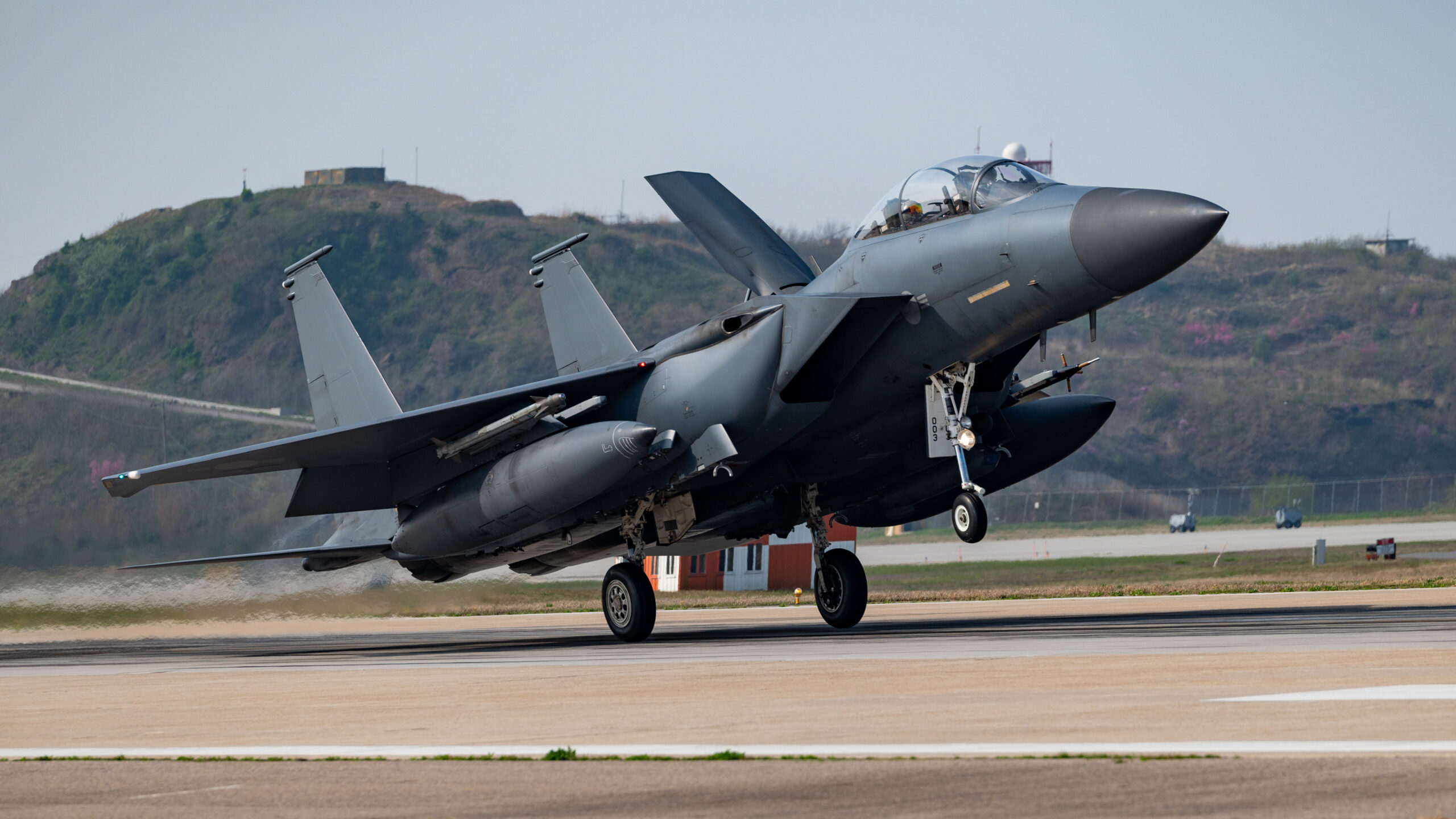
U.S. Approves Boeing deal to Upgrade Korean F-15K Fighters
The United States has awarded Boeing a contract valued at up to $2.81 billion to upgrade F-15K fighter aircraft operated by the Republic of Korea Air Force, according to a contract announcement released this week.
The undefinitized contract was issued to Boeing in St. Louis, Missouri, and covers the design and development of an integrated suite of aircraft systems to modernize South Korea’s F-15K fleet. The work will support modifications requested by South Korea’s Defense Acquisition Program Administration under the Foreign Military Sales framework.
According to the contract notice, the agreement is structured as a hybrid cost-plus-fixed-fee and fixed-price incentive contract and is capped at $2,805,961,005. Work will be performed in St. Louis and is scheduled to run through December 31, 2037. At the time of award, $540 million in Foreign Military Sales funds were obligated.
The contract was awarded as a sole-source acquisition, with the U.S. Air Force Life Cycle Management Center at Wright-Patterson Air Force Base in Ohio listed as the contracting activity.
The upgrade program will provide a new integrated avionics and mission system architecture for the F-15K, South Korea’s primary long-range strike and air superiority aircraft. While the contract notice does not list specific subsystems, such modernization programs typically involve radar, electronic warfare, communications, mission computing, and cockpit upgrades to extend service life and improve combat capability.
The F-15K, known locally as the Slam Eagle, is a customized variant of the F-15E Strike Eagle and forms a core part of South Korea’s air combat force. The aircraft is used for deep strike missions, air defense, and precision attack operations and is routinely tasked with high-readiness alert missions on the Korean Peninsula.
South Korea operates the F-15K alongside newer F-35A fighters, using the two types in complementary roles. The F-15K’s payload capacity, range, and two-seat configuration make it well suited for long-duration strike missions and command-and-control roles, while the F-35A focuses on penetration and stealth operations.
The modernization effort is intended to keep the F-15K operational and relevant through the 2030s and beyond as regional air forces continue to field more advanced aircraft, sensors, and air defense systems. The upgrades will also ensure interoperability with U.S. and allied forces operating under combined command structures.
The contract includes design and development work rather than immediate production, indicating that the program will proceed in phases, with system integration, testing, and validation carried out before fleet-wide installation begins. This approach is common for large-scale aircraft upgrades that involve multiple mission systems and long-term sustainment planning.
The F-15K upgrade program is managed under the Foreign Military Sales process, which allows the U.S. government to oversee contract execution, technical integration, and long-term support. This structure ensures compatibility with U.S. Air Force standards and simplifies logistics and training coordination between the two air forces.