


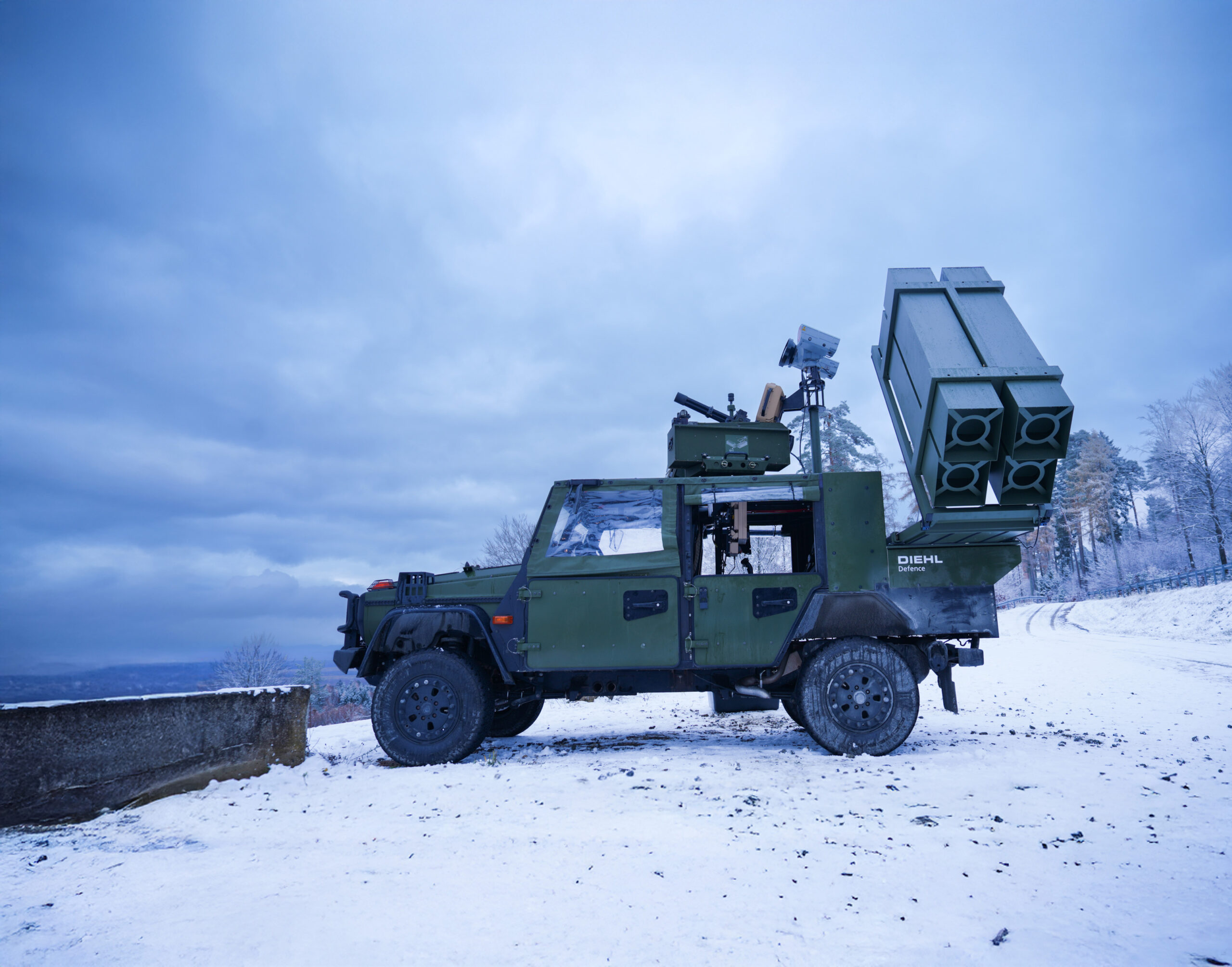
Germany’s firm Unveils GARMR counter-drone System
German defense company Diehl Defence unveiled the relaunch of its highly mobile counter-unmanned aerial vehicle system at the Enforce Tac exhibition in Nürnberg, introducing the platform under a new name, GARMR, replacing the previously known Kinetic Defence Vehicle (KDV).
According to Diehl Defence, GARMR represents a redesigned and expanded version of the earlier KDV system, integrating new interceptor drone types alongside an artificial intelligence-supported detection and decision-making architecture. The company presented the system publicly during Enforce Tac 2026, held from Feb. 23 to 25.
As noted by the company, GARMR is designed as a hybrid and modular counter-drone platform intended for a wide range of operational scenarios. The system can be deployed to protect critical civilian infrastructure, including buildings and large public events, while also supporting military operations in contested environments.
The platform operates through two parallel interceptor drone configurations. The GARMR SRS (Short Range System) employs the CICADA interceptor drone equipped either with a capture net or a warhead designed to neutralize aerial targets. The GARMR MRS (Medium Range System) expands engagement capability by using additional interceptor drones developed for longer-range threat interception.
Diehl Defence stated that both configurations allow integration of additional effectors depending on operational requirements. This modular approach enables operators to tailor the response, ranging from controlled interception suitable for sensitive civilian environments to higher-performance defensive actions against complex military drone threats at extended distances.
A central element of the GARMR relaunch is the introduction of AI-supported detection, identification, and prioritization functions. According to the company, modern algorithms automatically analyze incoming sensor data, classify aerial threats, and assist operators in decision-making processes.
The system combines detection sensors, identification modules, interceptor drones, and command elements on a highly mobile platform. Detection technology is designed to identify a broad spectrum of aerial targets, from small commercial multicopters to larger military unmanned systems, including combat drones such as the Shahed and Lancet.
Based on sensor input, identification modules classify detected objects and provide situational awareness to operators, enabling engagement decisions aligned with mission requirements. The integration of automated analysis aims to reduce response time against fast-moving or swarm drone threats.
Technically, counter-UAV systems such as GARMR operate through layered detection and interception. Sensors first detect airborne objects using radar or other monitoring technologies, after which software evaluates the threat and assigns engagement priorities. Interceptor drones are then launched to disable or capture hostile UAVs before they reach protected assets.
Diehl Defence said the relaunch under the name GARMR reflects an updated concept emphasizing interoperability, modular expansion, and user-focused operational flexibility. The system’s name references a watchdog figure from Nordic mythology, underscoring its intended role as a persistent defensive guardian against aerial threats.