

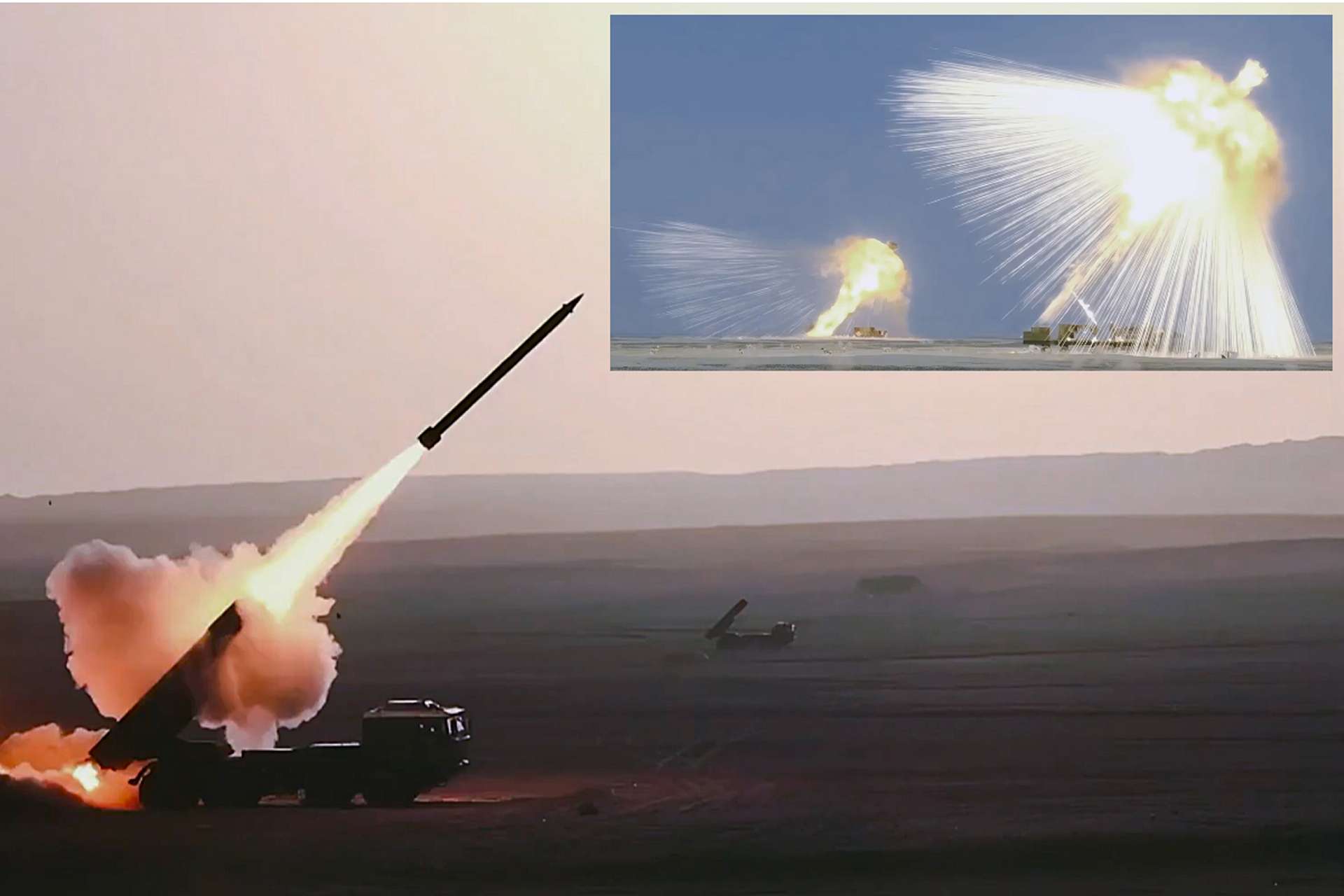
China has developed a new 370 mm airburst rocket projectile for the PHL-191 multiple launch rocket system (MLRS).
According to Poligonjournal, with these projectiles, salvo fire is replaced by a series of explosions above the surface of the target, without requiring a direct hit.
The PHL-191 is a wheeled modular system mounted on the chassis of the approximately 45-tonne 8×8 Wanshan 2400 truck. Its distinctive feature is its interchangeable launch containers, which allow for “Lego-like” combinations of different calibres depending on the mission.
During a test conducted in July this year, a 370 mm rocket projectile with a range of 300 km and an accuracy of up to 1 metre was used.
For comparison, the range of the US HIMARS MLRS with 227 mm GMLRS rockets is approximately 150 km, while the range of the Precision Strike Missile, which belongs to a different class, is approximately 400 km.
The main feature of the new rocket projectile is its ability to detonate in the air. Unlike a contact detonation, which is effective against concrete shelters, the programmable warhead detonates above the target surface and covers an area with a radius of up to several tens of metres with thousands of tungsten fragments.
The fragments destroy personnel, unarmoured vehicles, radar antennas and other vulnerable components.
The projectile achieves its accuracy through an integrated guidance system comprising inertial navigation (INS), BeiDou satellite correction and aerodynamic control fins. This enables the PHL-191 MLRS to perform missions with capabilities comparable to ballistic missiles, but at a significantly lower cost.
A single PHL-191 battalion consisting of 12 launchers can deliver a salvo of 96 projectiles, creating a density of fire that no air defence (AD) system can neutralise.
The modular design enables rapid reloading of the launchers. The chassis provides a maximum speed of up to 60 km/h and a range of 650 km.
Together with reconnaissance drones and satellite constellations, the system forms a “detect-and-cover” cycle, reducing the time from target detection to destruction to a matter of minutes.
According to experts, the remote-controlled “shredding” of enemy defences is beyond the capabilities of most NATO artillery systems. If airburst becomes the standard mode for 370 mm ammunition, this will change not only calculations concerning the number of projectiles striking a target, but also the tactics of ground operations anywhere in the world.
Əhəd Vahidoğlu


