
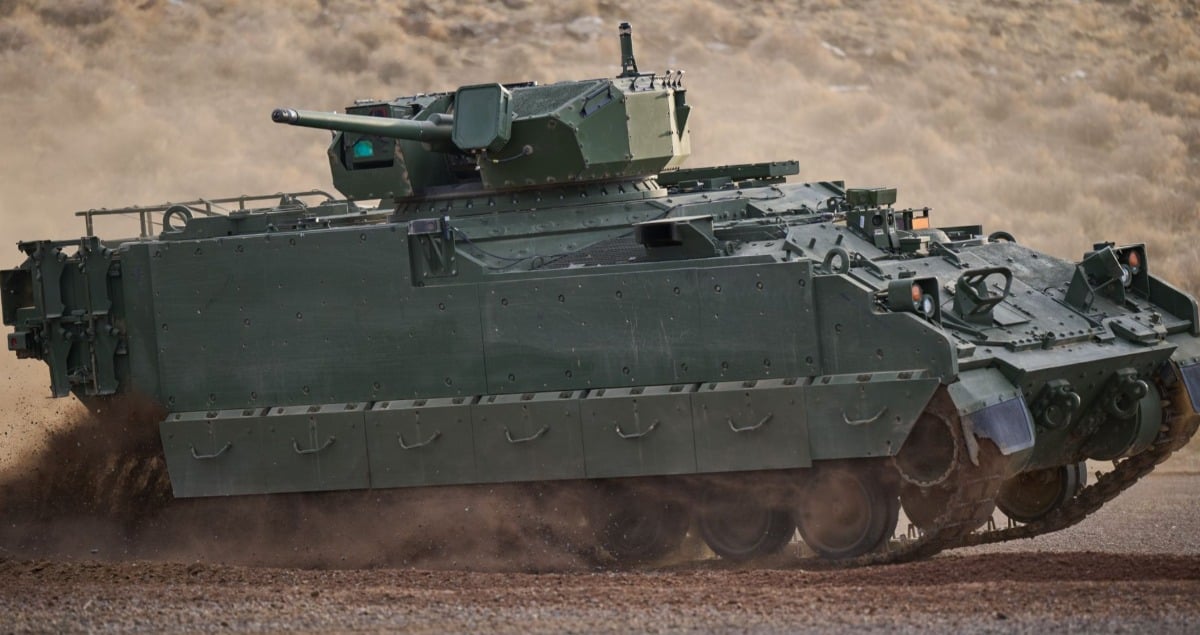
BAE Systems built an armored vehicle with drone-killing capabilities in ten months and put it in front of soldiers at Fort Hood, Texas, for training — without waiting for a government contract to fund it.
The AMPV-30, a version of the U.S. Army’s Armored Multi-Purpose Vehicle fitted with a 30mm cannon and a radar system for detecting and destroying small drones, has been running through training exercises with cavalry troopers and infantry soldiers from the 1st Cavalry Division as part of the Army’s Transformation in Contact program since late April 2026, according to William Sheehy, BAE Systems’ Vice President of Ground Maneuver Platforms.
The vehicle emerged from a deliberate decision by BAE to self-fund development after Secretary of War Pete Hegseth publicly challenged the defense industry to operate on a wartime footing and bring solutions to current battlefield threats without waiting for the traditional acquisition cycle. Sheehy confirmed in a social media post that BAE identified the problem, organized its own resources, and delivered two prototype vehicles to soldiers in ten months, a timeline that would normally represent a preliminary design review in government procurement terms, let alone a vehicle capable of conducting soldier training.
The Army and BAE both confirmed that the two AMPV-30s are company-funded prototypes participating in the Transformation in Contact 2.0 initiative, a program designed to accelerate evaluation of new capabilities by putting them directly in soldiers’ hands for field assessment. An Army spokesperson told The War Zone that the vehicles are “an internal research and development type effort from BAE Systems” and that “it is not something the Army procured, nor is there a requirement for the system at this time.” That distinction matters: despite social media posts from the 1st Cavalry Division that prompted widespread reporting of an actual fielding decision, the AMPV-30 is currently a prototype under evaluation, not a system the Army has committed to buy.
The vehicle’s anti-drone capability comes from a combination of two systems working together. The turret fitted to the AMPV-30 is Kongsberg Defence’s MCT-30, a Norwegian-designed remotely operated weapon station that mounts a Mk 44 Bushmaster II 30mm autocannon along with electro-optical and infrared cameras for targeting. The cannon fires programmable airburst munitions, rounds that can be set to detonate at a specific point in the air rather than on contact with a surface, which is how you kill a drone flying at altitude rather than waiting for it to fly directly into the barrel. The radar providing the detection layer for the AMPV-30 is the EchoShield system made by Echodyne, a cognitive Ku-band radar specifically engineered for detecting small unmanned aerial systems that fly low and erratically, according to Army Recognition. EchoShield operates in its C-UAS Mission Set mode during counter-drone operations, emphasizing short-range drone detection particularly in areas near the ground or along the horizon where drones most commonly appear, and can simultaneously track hundreds of airborne objects while cueing optical sensors and integrated command-and-control networks.
Armor expert Ronkainen, a well-followed analyst on X who tracks armored vehicle programs, clarified key technical details of the prototype: “Like mobile C-UAS sys tested under Flytrap, the AMPV-30 delivered to the 1st CAV is primarily intended to evaluate the RT20 turret to engage sUAS using PABM in conjunction with EchoShield radar. AMPV30 also features a common crew station to assess the operability of a 2-man crew.”
The AMPV itself is the Army’s tracked replacement for the M113 armored personnel carrier, a vehicle that has served since the early 1960s and which long-outlasted its intended service life in rear-area and support roles. BAE won the AMPV competition in 2014, with full-rate production beginning in 2023 to eventually replace nearly 3,000 M113 variants across armored brigade combat teams. The baseline AMPV comes in five variants covering general purpose transport, mortar carrier, mission command, medical evacuation, and medical treatment — none of which include a weapon heavier than a machine gun. The AMPV-30 represents a fundamentally different role, turning a support vehicle into something that can actively fight back against aerial threats alongside the Bradleys and Abrams tanks it travels with.
Sheehy described what the vehicle enables in direct terms: “For the first time ever CAV Troopers and Infantry Soldiers can execute their primary missions AND defend themselves against drone swarms. The AMPV-30s are radar equipped to detect small drones at long range and using the programmable air burst munition equipped 30mm they can destroy those drone swarms.” That framing reflects a genuine doctrinal gap the Army has been struggling to address. Armored brigade combat teams moving through contested territory are vulnerable to the kind of cheap, proliferated drone attack that has reshaped ground combat in Ukraine, where both sides use small first-person-view drones carrying grenades or shaped charges to attack vehicles that were never designed to defend against aerial threats.