
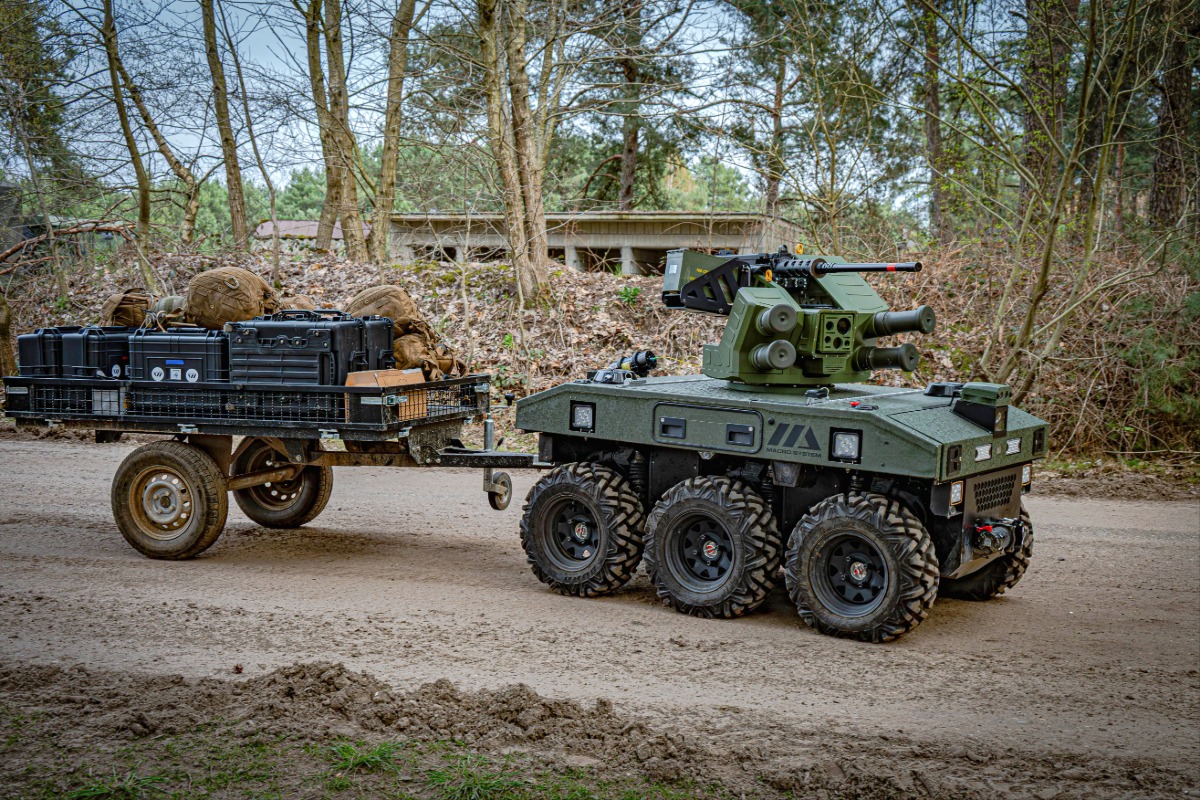
The Belgian Armed Forces have completed their first training exercise integrating unmanned ground vehicles into active operational scenarios, fielding Polish-made robotic systems across a range of missions including nighttime reconnaissance and target identification.
The exercise, conducted in Belgium, marked the Belgian military’s debut use of UGV platforms in a structured field environment — putting soldiers alongside machines in the kind of demanding, round-the-clock conditions that define modern high-intensity warfare. The systems used were developed by MACRO-SYSTEM, a Polish defense company that has been building ground robotics for several years.
Two platforms from MACRO-SYSTEM were at the center of the exercise. The GOBLIN unmanned combat and reconnaissance vehicle supported frontline units and helped identify enemy firing positions in real time. Working alongside it was the GNOM — a compact ground-launched loitering munition designed for fast, precise strikes in difficult and complex terrain. Together, the two systems cover fundamentally different ends of the battlefield robotics spectrum: one built to surveil, support, and persist; the other built to close, strike, and destroy.
The exercise ran around the clock, including night operations, with the unmanned platforms deployed across diverse and demanding environments. Soldiers used the systems for reconnaissance, logistics, and target identification — three of the most dangerous mission categories in modern land warfare, and three areas where keeping humans out of the direct line of exposure produces immediate tactical benefits. The exercise was designed as a pilot deployment, meaning the Belgian military was testing new operational concepts directly in the field rather than in a controlled laboratory setting.
The GOBLIN is a multipurpose unmanned ground vehicle built for both reconnaissance and combat roles. Its key operational strength is persistence — the platform can maintain continuous operations, including in night-time conditions, without the fatigue constraints that limit human operators. During the Belgian exercise, GOBLIN was used to support frontline units and identify enemy firing positions in real time, a task that in conventional operations exposes reconnaissance soldiers to some of the highest risks on the battlefield. The vehicle’s modular design allows it to be adapted for different sensor payloads and weapon system configurations depending on mission requirements, making it a flexible platform rather than a single-purpose tool.
The GNOM is a different kind of system entirely. Compact, fast, and expendable, it functions as a ground-launched loitering munition — essentially a wheeled kamikaze drone that moves along the surface rather than through the air. Weighing just 7 kilograms and capable of reaching 80 kilometers per hour, GNOM can approach targets at speed across terrain that airborne loitering munitions cannot easily access, including forested areas, urban corridors, and rough ground that disrupts aerial flight paths. Its onboard camera gives operators real-time video during the approach, and its interchangeable warhead system — including cumulative, high-explosive, and thermobaric variants — allows it to be configured against armored vehicles, personnel, light structures, or hardened positions. With a control range of 500 meters, it operates close to the front, where the margin for error is smallest and the need for precision is highest.
Poland’s MACRO-SYSTEM has been building credibility with these platforms through a series of high-profile exercises before the Belgian deployment. The company tested GNOM and GOBLIN together during Poland’s Iron Gate 25 exercise with the 18th Mechanized Division, where GNOM conducted reconnaissance missions, kinetic strikes, and command post raids, while GOBLIN handled manned-unmanned teaming with Rosomak armored personnel carriers, route reconnaissance, and logistical tasks including towing loads of up to 16 tons. GOBLIN demonstrated an operational endurance of approximately 20 hours on a single battery charge during that exercise — a figure that makes it genuinely useful for sustained operations rather than short demonstration runs. The company also showcased GNOM at Denmark’s DALO Industry Days and Uncrewed Innovation Day, where it drew attention from European armed forces representatives.
For MACRO-SYSTEM, the Belgian exercise represents the company’s first confirmed deployment of its systems with a Western European military outside Poland. That is a significant threshold. European defense budgets are expanding, UGV procurement is accelerating, and the market for proven, field-tested ground robotics is intensifying. The Belgian Armed Forces were not just testing new hardware — they were validating a concept that a growing number of European armies are watching closely.