
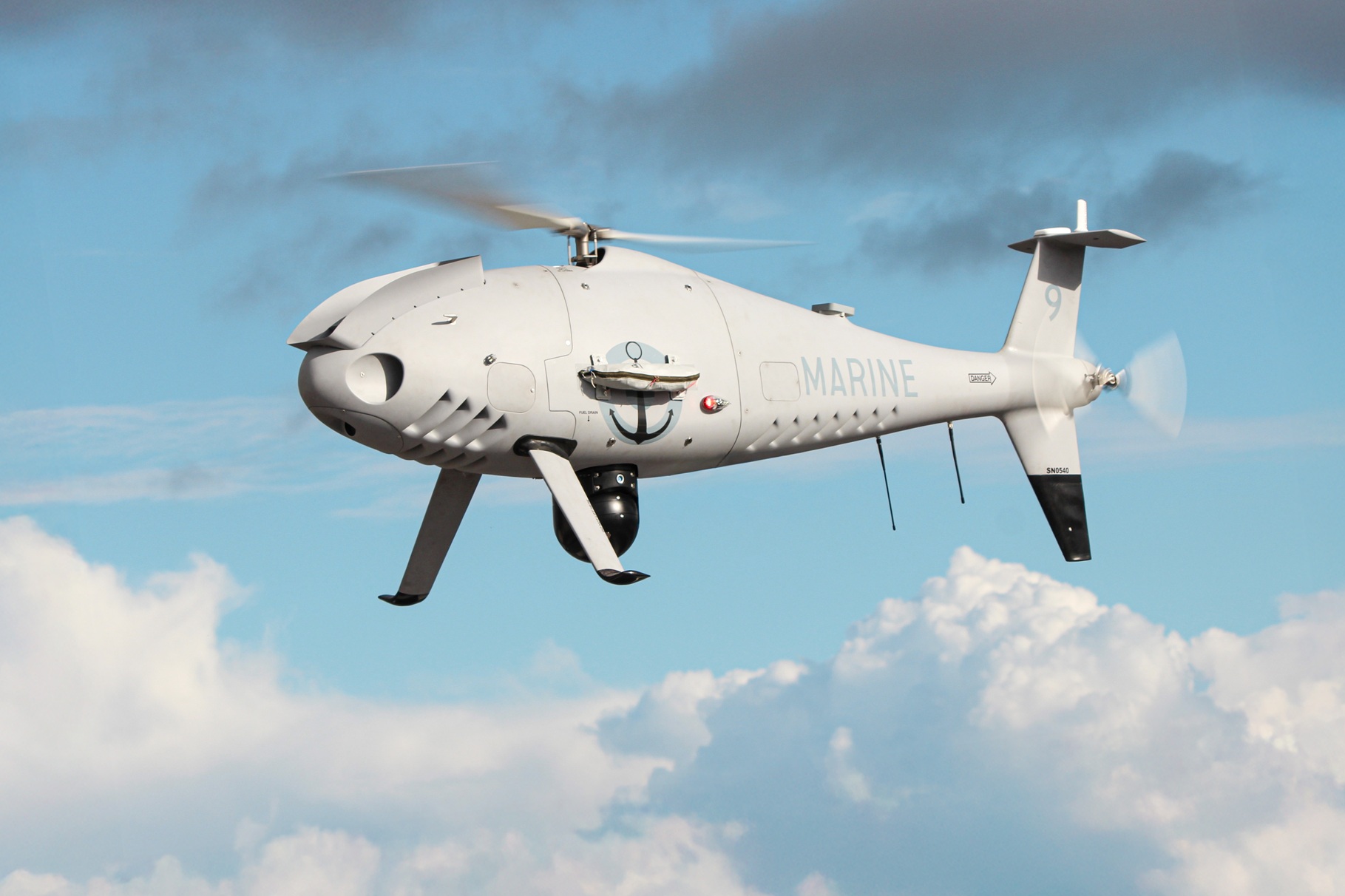
The French Navy has ordered five additional CAMCOPTER S-100 unmanned aerial systems under its naval unmanned aviation program, expanding its existing fleet and deepening the service’s long-running use of shipborne rotary-wing drones across multiple vessel classes.
The order was placed through France’s defense procurement and technology agency, the Direction Générale de l’Armement (DGA), with Naval Group serving as prime contractor and lead systems integrator. Under the agreement, Naval Group will deploy and integrate the additional systems aboard the French Navy’s Frégates Européennes Multi-Mission, or FREMM frigates, while also providing mission management integration through the Steeris MS system.
Each ordered system includes two CAMCOPTER S-100 unmanned air vehicles, bringing the French Navy’s total inventory to eight S-100 systems once all deliveries are completed. Deliveries are scheduled to begin progressively in 2026, according to the official announcement.
The procurement is a clear continuation of a capability the French Navy has been building for more than a decade. The service first began operating the CAMCOPTER S-100 at sea in 2012, when the aircraft was fully integrated aboard the Gowind-class offshore patrol vessel L’Adroit. That initial integration established one of the earliest examples in Europe of a rotary-wing unmanned aircraft being used as an organic naval surveillance asset from a warship.
The program expanded further in 2019, when the S-100 was integrated aboard the Mistral-class amphibious helicopter carrier Dixmude. That milestone was especially notable because it marked the first operational integration of a rotary-wing unmanned air system into a European naval combat management system. One year later, the French Navy added two more S-100 systems, which were then deployed aboard Mistral and Tonnerre.
The latest order pushes the French Navy’s investment in maritime unmanned aviation further toward fleet-wide operational use, particularly aboard frontline surface combatants such as the FREMM class. These frigates are among the Navy’s most capable multipurpose warships and are routinely employed in anti-submarine warfare, air defense, maritime security, and long-range deployment missions.
The CAMCOPTER S-100 itself is a vertical takeoff and landing unmanned aerial system designed specifically for flexible maritime and expeditionary operations. One of its main advantages is that it does not require dedicated launch or recovery equipment, allowing it to operate directly from ship decks with a relatively small footprint. That feature makes it particularly suitable for vessels where deck space and onboard support infrastructure are limited.
Its primary role in naval service is maritime intelligence, surveillance, and reconnaissance, often abbreviated as ISR. In practical use, that means extending the sensing and observation range of the ship carrying it. From a general audience perspective, the drone effectively acts as an airborne set of eyes far beyond the horizon, giving commanders access to real-time imagery and situational awareness that the ship’s onboard radar and visual systems alone may not provide.
For France, the expansion of the S-100 fleet aligns with its longstanding emphasis on flexible expeditionary naval operations. FREMM frigates frequently operate far from home waters, including in the Mediterranean, the Atlantic, and Indo-Pacific deployments. An onboard vertical takeoff drone significantly expands the surveillance envelope available to commanders during these missions.
Lubos Sramek, Director of Schiebel Aéronaval SAS in Toulon, said the repeat order reflects both the maturity of the system and the French Navy’s confidence in its operational performance at sea.
“The French Navy was among the first European naval forces to operationally integrate the CAMCOPTER S-100 into its shipborne operations. This follow-on order reflects the system’s capabilities, as well as maturity and the confidence placed in its performance at sea. We are proud to continue supporting the French Navy with a proven and operationally deployed VTOL UAS,” he said.
With deliveries beginning in 2026 and integration planned aboard FREMM frigates, the latest order reinforces France’s position as one of Europe’s early adopters of operational naval unmanned aviation and extends a capability the service has now employed globally for more than a decade.