
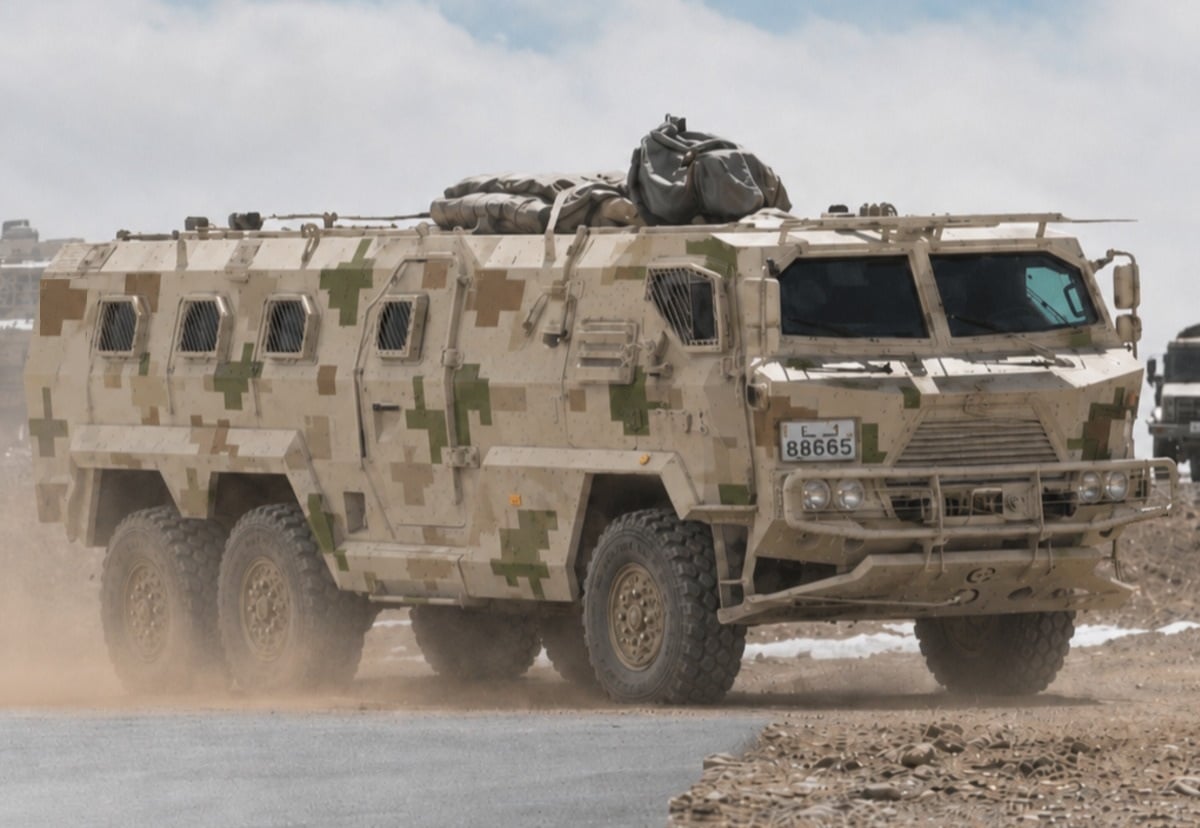
Chinese state television has aired footage of a new armored troop transport vehicle conducting high-altitude driving exercises on the Tibetan Plateau, offering the clearest public look yet at what appears to be a purpose-built solution to one of the People’s Liberation Army’s most persistent logistical problems: how to move infantry safely across one of the world’s most hostile operating environments.
The footage, broadcast on CCTV-7, China’s dedicated military and defense channel, shows convoys of the new vehicles operating across arid, high-altitude terrain with snow-capped mountains visible in the background. On-screen text identifies the broadcast as part of a segment on multi-subject driving training aimed at improving plateau transport support capability, framed under China’s broader campaign to comprehensively strengthen military training and combat readiness.
The new vehicle visible in the footage is built on the FAW MV3 chassis, a six-wheel-drive military truck that has served as the People’s Liberation Army’s standard tactical logistics platform since 2011, and represents a significant structural departure from the open-bed canvas-covered configuration that most MV3 variants use in service.
The FAW MV3, produced by First Automobile Works, one of China’s major state-owned vehicle manufacturers, is the third-generation standardized military truck adopted across PLA ground force units. The 6×6 configuration offers five-ton payload capacity and cross-country mobility suited to the difficult road networks of western China, and the platform has been adapted for multiple roles including missile carrier systems, border patrol vehicles, and logistics transport. What the CCTV footage appears to show is a new variant in which the standard truck cab and cargo bed have been replaced by an integrated armored capsule, combining the driver’s compartment and troop-carrying section into a single enclosed, protected structure.
The military logic behind this development is straightforward and grounded in a problem the PLA has documented openly for years. The Tibetan Plateau, which China administers as the Tibet Autonomous Region and where the PLA maintains substantial military forces along disputed borders with India, sits at average elevations between 4,000 and 5,000 meters above sea level. At those altitudes, temperatures regularly fall well below minus 20 degrees Celsius, oxygen levels drop to roughly 60 percent of sea-level density, and wind conditions can incapacitate unprotected personnel within hours.
Moving infantry in open-backed trucks across the plateau is not simply uncomfortable; it degrades combat readiness by the time troops arrive at their destination. A vehicle that keeps soldiers warm, oxygenated, and protected during transit addresses a genuine operational requirement that canvas covers and insulated jackets cannot adequately solve.
Prior reporting on this vehicle variant, including coverage by China Defense Blog, indicates the armored transport can carry 22 fully armed PLA infantry, with the cabin insulated and heated for sustained high-altitude operations. The interior layout places troops in the center of the vehicle facing outward toward the sides rather than in a conventional forward-facing bench configuration, with soft suspension seating designed to absorb the impact of rough plateau terrain during long transits. Firing ports and observation hatches in the hull sides and roof allow the occupants to engage threats from within the vehicle without dismounting, a feature that distinguishes this platform from a purely logistical transport and gives it a degree of tactical utility in the kind of ambush scenarios that high-altitude border roads can present.
The vehicle is notably unarmed in the conventional sense, carrying no external weapons stations, no pintle-mounted machine guns, and no remote turret systems. Its protection is oriented inward, designed to keep occupants alive during contact rather than to suppress threats from a distance. This design philosophy, prioritizing survivability and tactical mobility over offensive firepower, reflects a PLA approach to the high-altitude logistics problem that emphasizes getting infantry to the fight in fighting condition rather than building a multi-role combat platform.
The specific designation of the new Chinese armored transport remains unknown from public sources. The CCTV footage provides enough visual detail to confirm its FAW MV3 derivation and its general configuration, but the vehicle has not been officially named or announced through Chinese defense ministry channels. Whether it represents a serial production platform already entering service with Tibet and Xinjiang military commands, or a developmental vehicle being evaluated in field conditions, cannot be determined from the available footage. What the broadcast makes clear is that the PLA considers high-altitude troop transport capability significant enough to showcase publicly on national military television, which in the context of Chinese information management practices is itself a statement of institutional priority.
Getting soldiers to the top of the world in condition to fight remains one of the most difficult logistical challenges any military can face. China appears to have built something that addresses it.