

Israeli Satellite now Tracks Moving Targets day and Night
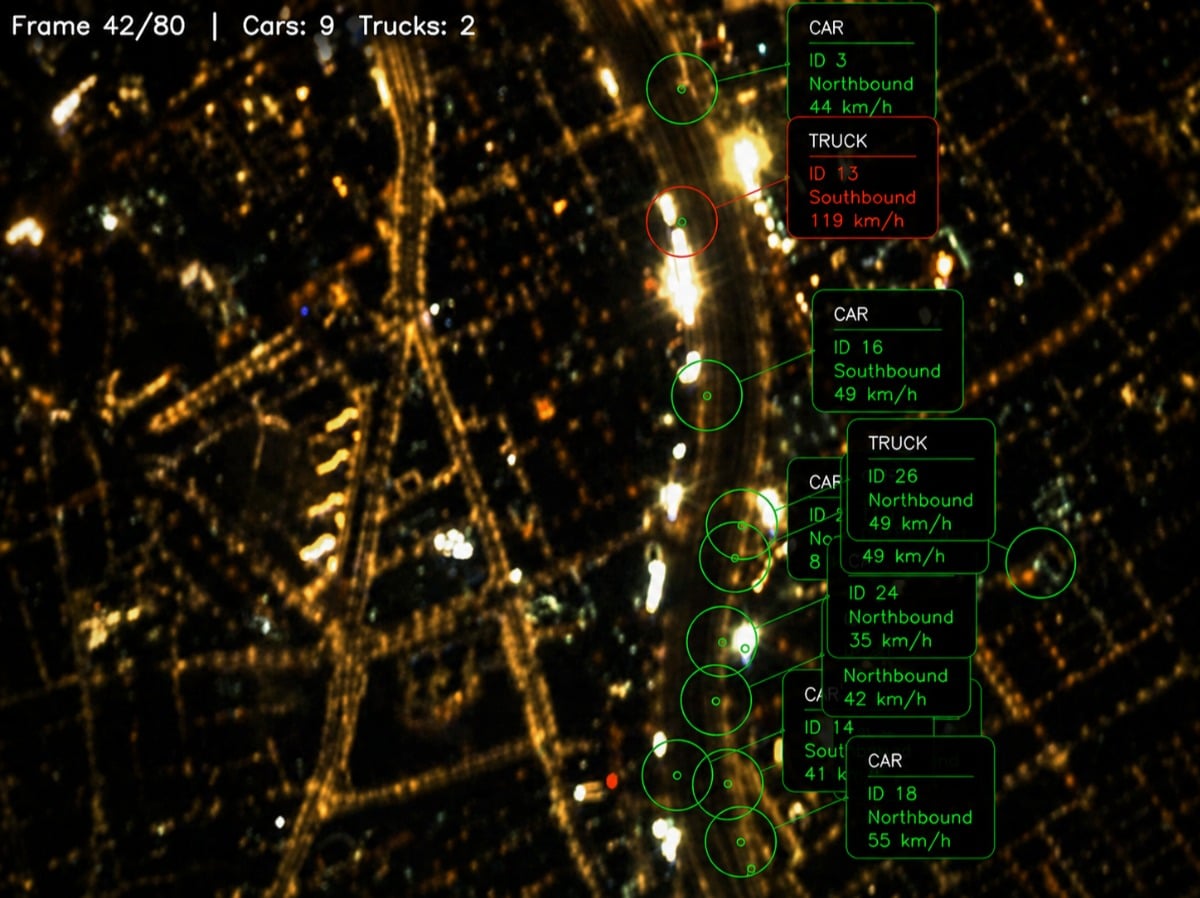
An Israeli satellite company announced on May 26 that its RUNNER satellite can now detect and track moving objects from orbit around the clock, including at night, a capability the company describes as the first of its kind in persistent space-based surveillance.
ImageSat International said the new capability uses onboard artificial intelligence to autonomously detect, classify, and characterize movement patterns directly on the satellite rather than transmitting raw imagery to the ground for processing, delivering finished intelligence to users in near real time.
The distinction between processing data on the satellite and transmitting it to the ground first is more consequential than it might initially appear. Traditional Earth observation satellites collect imagery and beam it to ground stations, where analysts or automated systems then work through the data to find what matters. That pipeline introduces latency measured in minutes to hours depending on ground station availability, downlink capacity, and processing queue depth. RUNNER’s onboard AI compresses that pipeline by doing the analysis in orbit, transmitting only the processed intelligence output rather than the full raw video stream. The result is faster delivery, more efficient use of the limited radio bandwidth available for downlinking data from orbit, and a system that can serve users who need actionable information quickly rather than raw imagery they must interpret themselves.
The nighttime tracking capability is the technical breakthrough that gives the announcement its operational weight. Optical satellite intelligence has historically been constrained by daylight and cloud cover in ways that radar imagery is not, because cameras require photons and nighttime provides very few of them at the light levels that allow useful image resolution from hundreds of kilometers above the Earth. ISI says RUNNER overcomes this through a novel optical system design that captures sufficient photon data under low-light nighttime conditions, combined with AI-driven algorithms that can extract reliable movement signatures from video that traditional optical systems would consider too degraded to use. The company has not disclosed the specific sensor technology enabling this, attributing it to a novel optical system design, a claim that carries the caveat of unverified proprietary technology.
What that nighttime capability means for defense and intelligence customers is the closure of a gap that adversaries have historically exploited. Military logistics, troop movements, and vehicle convoys that occur at night have long been harder to monitor from space than daytime activity, which is one reason why military operations frequently begin or occur at night. A satellite that can maintain continuous movement detection regardless of the time of day removes that predictable blind spot from the surveillance picture, giving commanders and intelligence analysts a persistent overhead view of activity across an area of interest that does not reset at sunset.
The scale of coverage RUNNER claims is also notable. The system’s movement detection operates across vast operational areas and dense traffic environments including city-scale coverage, according to ISI, meaning the algorithm can distinguish militarily relevant movement from the background noise of civilian vehicles, pedestrians, and other activity in populated areas. That kind of discrimination at city scale is a genuinely difficult computer vision problem, requiring training on large datasets of diverse movement signatures and robust classification models that can handle variation in vehicle types, speeds, and behavioral patterns. ISI attributes this to its advanced onboard AI and embedded processing without specifying the underlying architecture, and the claim should be understood as the company’s characterization of its own system rather than independently verified performance data.
Noam Segal, ISI’s chief executive, described what the expanded capability represents for the intelligence market: “RUNNER is redefining the role of satellites in operational intelligence. The ability to detect and analyze movement persistently from orbit, across day and night, and deliver actionable intelligence in real time, fundamentally changes what defense and intelligence organizations can expect from space-based assets.”
The commercial and strategic context for this announcement reflects a broader transformation in space-based intelligence that has accelerated over the past decade. The entry of commercial operators into the Earth observation market, driven by lower launch costs and advances in small satellite technology, has dramatically expanded the number of satellites collecting imagery and the frequency with which any given location can be revisited. Companies like Planet Labs, Maxar, and Satellogic have built constellations that can image most of the Earth’s surface multiple times per day, and the intelligence agencies of multiple nations now routinely use commercial imagery to supplement or replace national technical means for lower-priority collection requirements. RUNNER’s onboard processing and nighttime movement detection capability represents an attempt to differentiate within that increasingly crowded market by offering not just imagery but processed intelligence delivered faster than traditional architectures allow.
The implications extend beyond military customers. Border security agencies, disaster response coordinators, maritime domain awareness programs, and infrastructure protection operations all have legitimate uses for persistent overhead movement detection that does not depend on daylight. ISI’s dual-use framing of RUNNER’s capabilities as serving both defense and intelligence organizations reflects the commercial reality that the market for this kind of persistent surveillance is broader than any single government application.