
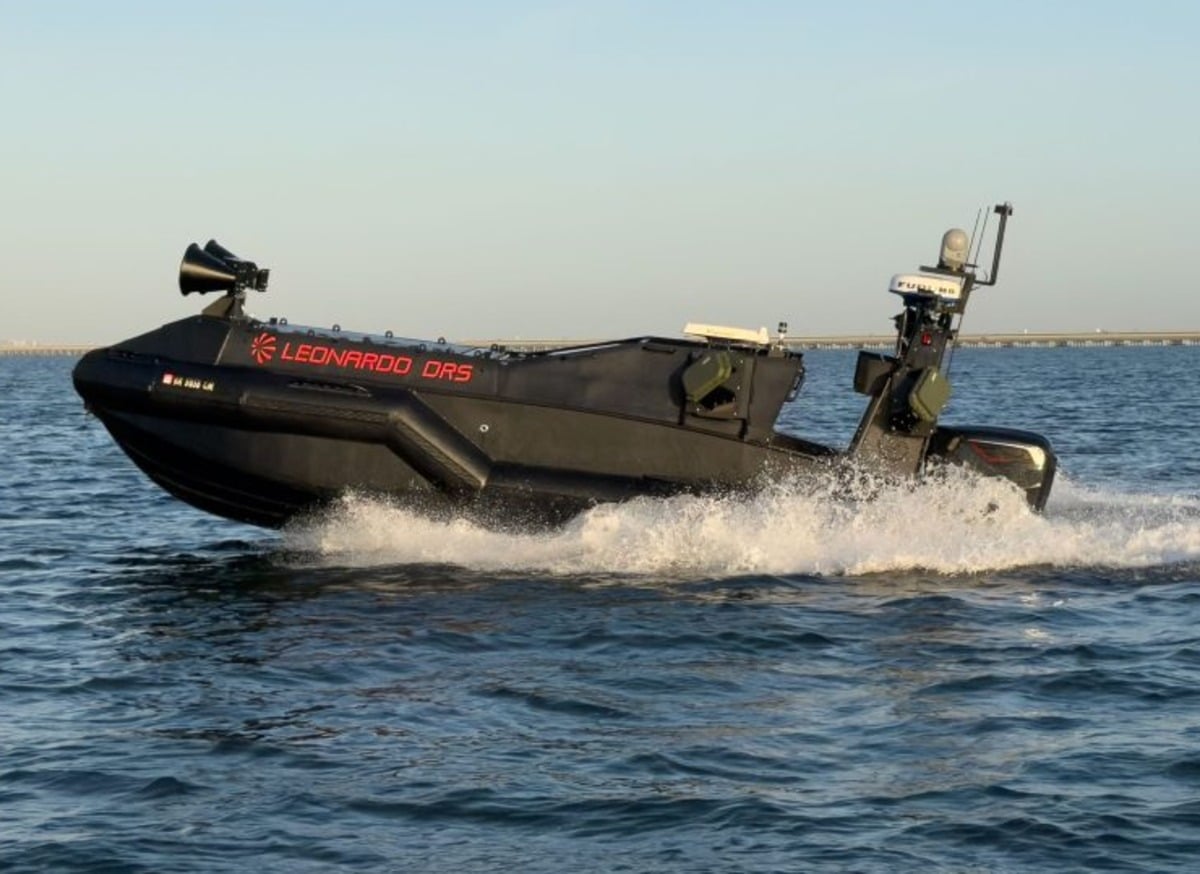
Leonardo DRS has successfully integrated its Maritime Mission Equipment Package onto an autonomous unmanned surface vessel, delivering a new counter-drone capability designed to detect, track, identify, and defeat aerial unmanned threats in the maritime domain.
The company announced the integration ahead of its showcase at the Navy League Sea-Air-Space Symposium, where the M-MEP will be displayed aboard the Sea Machines STORMRUNNER autonomous unmanned surface vessel at Dock 9 outside the exhibition hall.
The system is built around a modular architecture intended to compress the time between identifying a requirement and fielding an operational capability — a persistent challenge in counter-drone procurement, where the threat has consistently outpaced acquisition timelines. Rather than requiring a purpose-built vessel or extensive platform modifications, the M-MEP packages sensors, command and control software, and defeat options into a single integrated system with a platform integration kit designed to accelerate installation across multiple vessel types, including both crewed ships and uncrewed surface vessels.
Cari Ossenfort, senior vice president and general manager of Leonardo DRS Naval Electronics, framed the integration challenge directly. “Aerial unmanned threats are evolving quickly — in range, autonomy, and numbers,” Ossenfort said. “The M-MEP is engineered to help the U.S. Navy and allied forces stay ahead of that threat with a modular package that brings sensors, command and control, and defeat options together into one integrated capability that can be fielded fast.”
The M-MEP’s sensor suite combines maritime radar with electro-optical and infrared sensors, providing the detection and identification coverage needed to separate genuine drone threats from the cluttered maritime environment — a backdrop filled with birds, surface contacts, and other false targets that can overwhelm less capable systems. Those sensors feed into the SAGEcore software platform, a Leonardo DRS-developed system that applies artificial intelligence-enabled sensor fusion to correlate inputs from multiple sensors and present operators with a unified tactical picture rather than raw data streams from disconnected sources. The AI-assisted fusion reduces the cognitive burden on operators and shortens the time required to classify a contact and authorize a response.
Placing that capability on the Sea Machines STORMRUNNER — an autonomous unmanned surface vessel — extends maritime counter-drone protection beyond crewed ships into the unmanned domain. An autonomous USV carrying its own C-UAS package can operate independently in areas where placing a crewed vessel would be impractical or unnecessarily risky, providing a persistent drone-detection picket around a port, a high-value ship, or a littoral infrastructure site without requiring a sailor aboard. That combination — unmanned platform, autonomous operation, integrated counter-drone defeat — represents a meaningful leap in how layered maritime defense can be constructed.
The drone threat to maritime operations has shifted from a theoretical concern to an operationally validated problem over the past several years. Commercial quadcopters have been used to surveil naval vessels in port, and more capable long-range unmanned systems have demonstrated the ability to threaten ships operating in contested littoral environments. The Houthi drone and missile campaign against commercial and naval shipping in the Red Sea brought that threat into sharp public focus, illustrating how even relatively low-cost aerial systems can force expensive defensive responses and operational disruptions across an entire theater.