
MH-60R Seahawk Gets Nearly $100M Radar Brain Upgrade
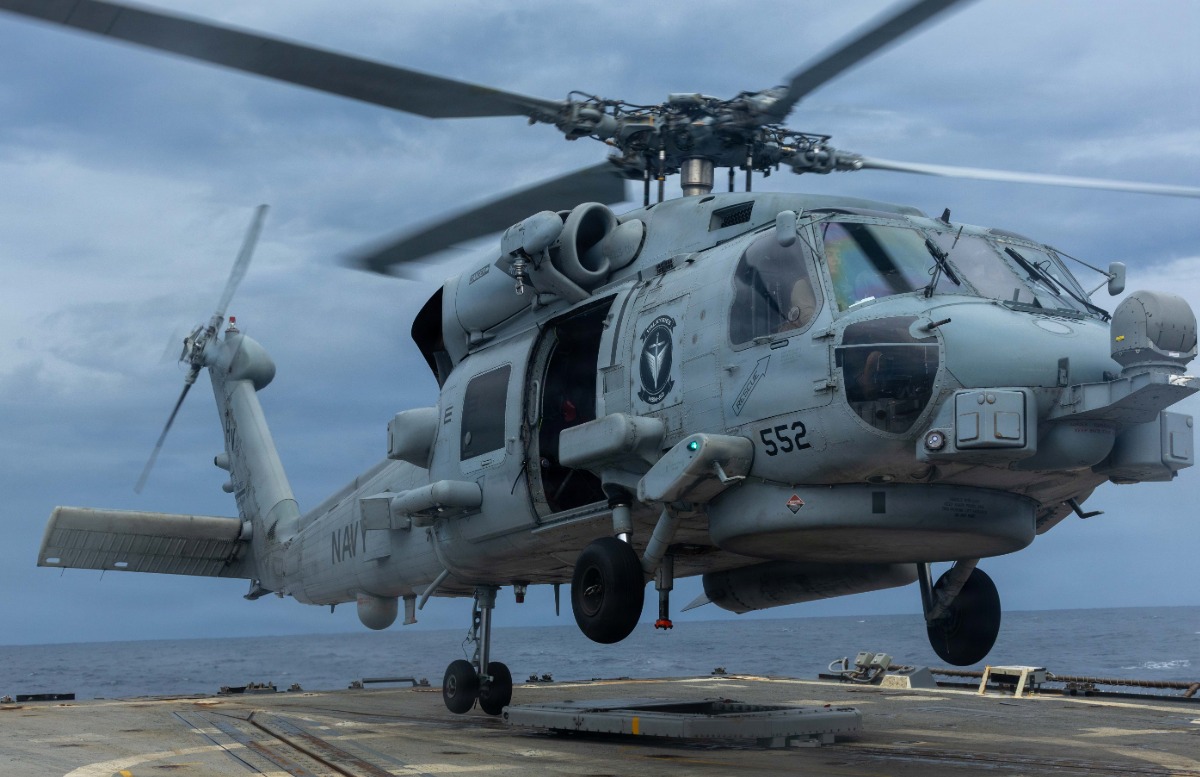
The U.S. Navy is modernizing the radar brain of its primary submarine-hunting helicopter, awarding Lockheed Martin nearly $100 million to refresh the data processing technology at the core of the MH-60R Seahawk’s AN/APS-153 radar system.
Naval Air Systems Command handed Lockheed Martin Rotary and Mission Systems a $99,481,601 order against a previously issued basic ordering agreement, tasking the company’s Owego, New York operation with designing, developing, integrating, and testing a radar data processor technology refresh for the AN/APS-153. The work covers both U.S. Navy variants and Foreign Military Sales versions — meaning allies who fly the MH-60R get the same upgrade pipeline. Completion is expected in April 2031.
The AN/APS-153 is one of the more consequential pieces of electronics flying over the world’s oceans today. The system equips the MH-60R Seahawk, the Navy’s primary anti-submarine and anti-surface warfare helicopter, and gives it the ability to detect submarines running near the surface, track small surface contacts, and maintain situational awareness across a wide maritime search area. The radar works alongside the Seahawk’s sonobuoy systems, dipping sonar, and torpedoes to make the MH-60R the Navy’s most capable rotary-wing hunter of undersea threats. Keeping that radar current — particularly its data processing core — is not optional maintenance. It is the difference between a sensor that can handle modern signal environments and one that cannot.
The data processor is where raw radar returns become usable information. It filters clutter, discriminates targets, tracks contacts, and feeds processed data to crew displays and other onboard systems. Technology refreshes of this component reflect a reality common across military electronics: the aircraft and its airframe can remain in service for decades, but the processors inside age faster than the platform itself. Commercial semiconductor advances, changes in the threat environment, and the growing complexity of electronic warfare all create pressure to update the processing layer even when the rest of the system remains sound. This contract funds exactly that — pulling the existing processor architecture forward to keep pace with what the radar needs to do in a more demanding operational environment.
Work will be distributed across three sites. Farmingdale, New York carries the largest share at 68 percent, with Owego — Lockheed Martin’s rotary and mission systems hub — handling 31 percent, and Stratford, Connecticut accounting for the remaining one percent. The geographic spread reflects how large defense electronics programs actually function: specialized engineering work distributed across facilities with distinct competencies, coordinated under a single prime contractor.
Funding comes from two streams. The Navy is obligating $6,500,000 in fiscal 2026 research, development, test and evaluation funds at the time of award. An additional $14,500,000 comes from Foreign Military Sales funds — a figure that reflects real international demand for the upgraded capability. Several U.S. allies operate the MH-60R, including Australia, Denmark, Greece, India, Saudi Arabia, and others, and those nations have a direct stake in keeping their aircraft’s radar systems current alongside the U.S. fleet. Neither funding tranche will expire at the end of the fiscal year, giving the program budget stability across its development timeline.
The MH-60R itself is a mature platform with a long service horizon ahead of it. The Navy fields a substantial fleet, and allied operators have invested heavily in the type. That scale makes radar processor modernization economically sensible — a single upgrade that applies across hundreds of aircraft and multiple national fleets generates far more operational return than the per-unit investment might suggest. It also means the development work Lockheed Martin does in Farmingdale and Owego over the next five years will shape the radar capability of a significant portion of the Western world’s maritime patrol helicopter force.
Naval Air Systems Command at Patuxent River, Maryland, the Navy’s primary aviation acquisition command, is the contracting activity — as it is for virtually every naval aviation electronics program of this kind.
Anti-submarine warfare runs on information quality. A submarine detected late, or not at all, is a threat that cannot be countered. The MH-60R’s radar is one of the sensors that keeps that detection chain intact, and the data processor sitting at its center determines how well the system handles whatever the ocean — and an adversary — throws at it.