
A small California company just won nearly three-quarters of a billion dollars to operate some of the U.S. Navy’s most strategically sensitive ships — vessels that hunt submarines and track missile tests across the world’s oceans.
Patriot Contract Services LLC, headquartered in Concord, California, received a firm-fixed-price award fee contract (N3220526C4070) valued at $746 million on April 27, 2026. The deal covers operation and maintenance of the Navy’s T-AGOS and T-AGM fleet — two distinct ship classes bundled under a single contract and collectively responsible for capabilities that sit at the heart of undersea warfare and weapons development.
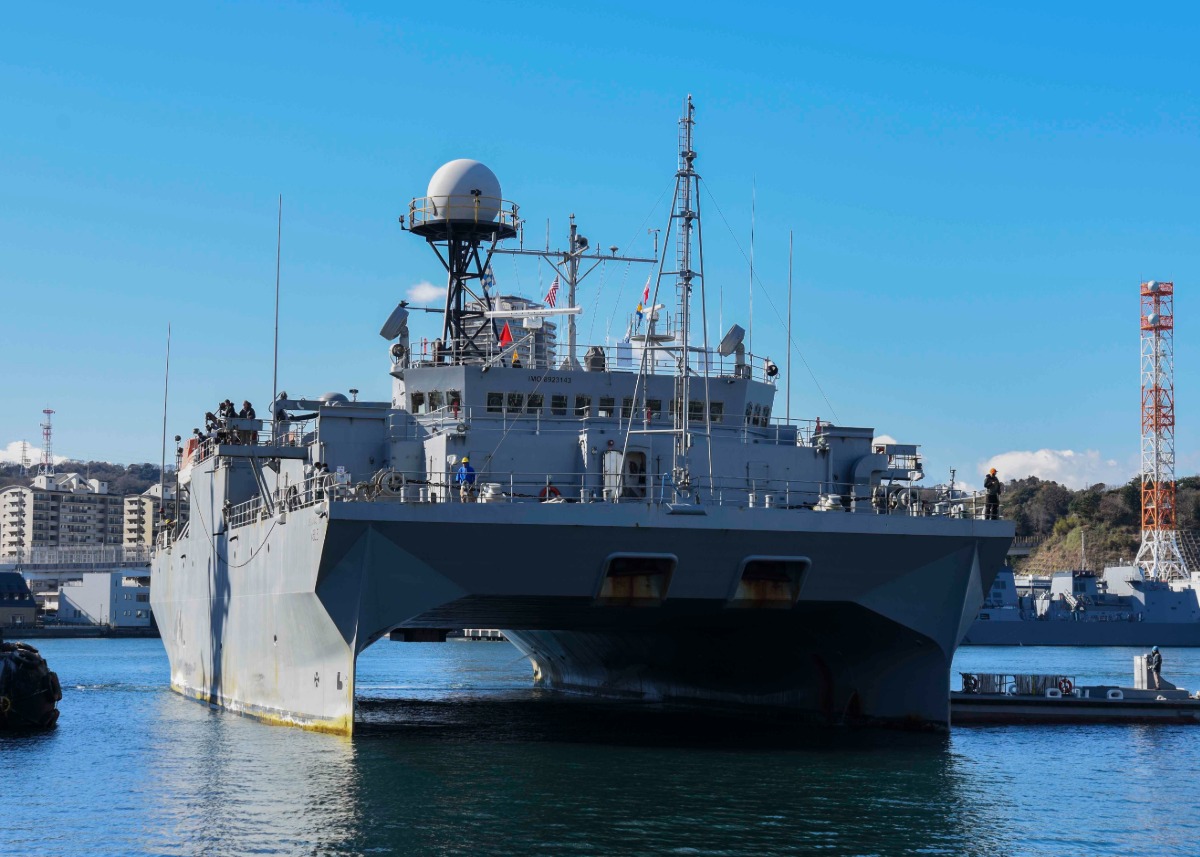
The T-AGOS designation stands for Transportation Auxiliary General Ocean Surveillance, and these ships do exactly what that unwieldy name implies — they listen. Equipped with the Navy’s Surveillance Towed Array Sensor System, known as SURTASS, T-AGOS vessels drag enormous passive sonar arrays through the deep ocean, detecting and tracking submarines at ranges that no surface combatant could replicate. The physics of deep-ocean acoustics favor a slow, quiet ship towing a very long sensor string, and T-AGOS vessels are purpose-built around that reality. As Chinese and Russian submarine programs push harder for range, quieting, and endurance, the American ability to monitor those boats from a distance becomes more valuable — not less.
The T-AGM ships in the contract are a different animal entirely. Transportation Auxiliary General Missile Range Instrumentation vessels are the Navy’s floating test ranges — platforms packed with radars, telemetry receivers, and tracking systems that observe missile tests from downrange positions. When a ballistic missile, cruise missile, or hypersonic test vehicle launches, a T-AGM ship is often out there watching, measuring velocity, tracking trajectory, and recording data that weapons engineers and defense planners will spend months analyzing. They also play a role in arms control verification, providing independent technical measurement of missile performance parameters. It is unglamorous work that happens far from port, far from cameras, and far from public awareness — but the data these ships collect shapes weapons programs and arms control negotiations alike.
Military Sealift Command, the Norfolk, Virginia-based command that operates the Navy’s civilian-crewed auxiliary fleet, ran the competition as a total small business set-aside, barring large defense contractors from bidding. Four proposals arrived through the Government Point of Entry website — the federal procurement portal used for competitive solicitations — and Patriot Contract Services emerged as the winner.
The contract structure mirrors the standard Military Sealift Command model: a 12-month base period, four additional 12-month option periods, and a final six-month extension available under Federal Acquisition Regulation 52.217-8. Performance begins with vessel delivery in 2026 and runs through 2032 if all options are exercised — a five-and-a-half-year commitment. Working capital funds in the amount of $18,165,081 are obligated immediately for fiscal 2026, money that will not expire when the fiscal year closes.
That Patriot Contract Services won this award as a small business says something about how Military Sealift Command approaches auxiliary fleet operations. The command has long favored small business set-asides for vessel operation contracts, a model built on the recognition that civilian maritime expertise — not defense industry scale — is what actually keeps these ships running. Operating a T-AGOS or T-AGM vessel doesn’t require a large prime contractor’s overhead structure. It requires experienced mariners, competent engineers, and a logistics organization capable of sustaining ships deployed far from home port for extended periods. Small companies with the right maritime pedigree can do that work, and Military Sealift Command has consistently structured its contracts to let them compete for it.