
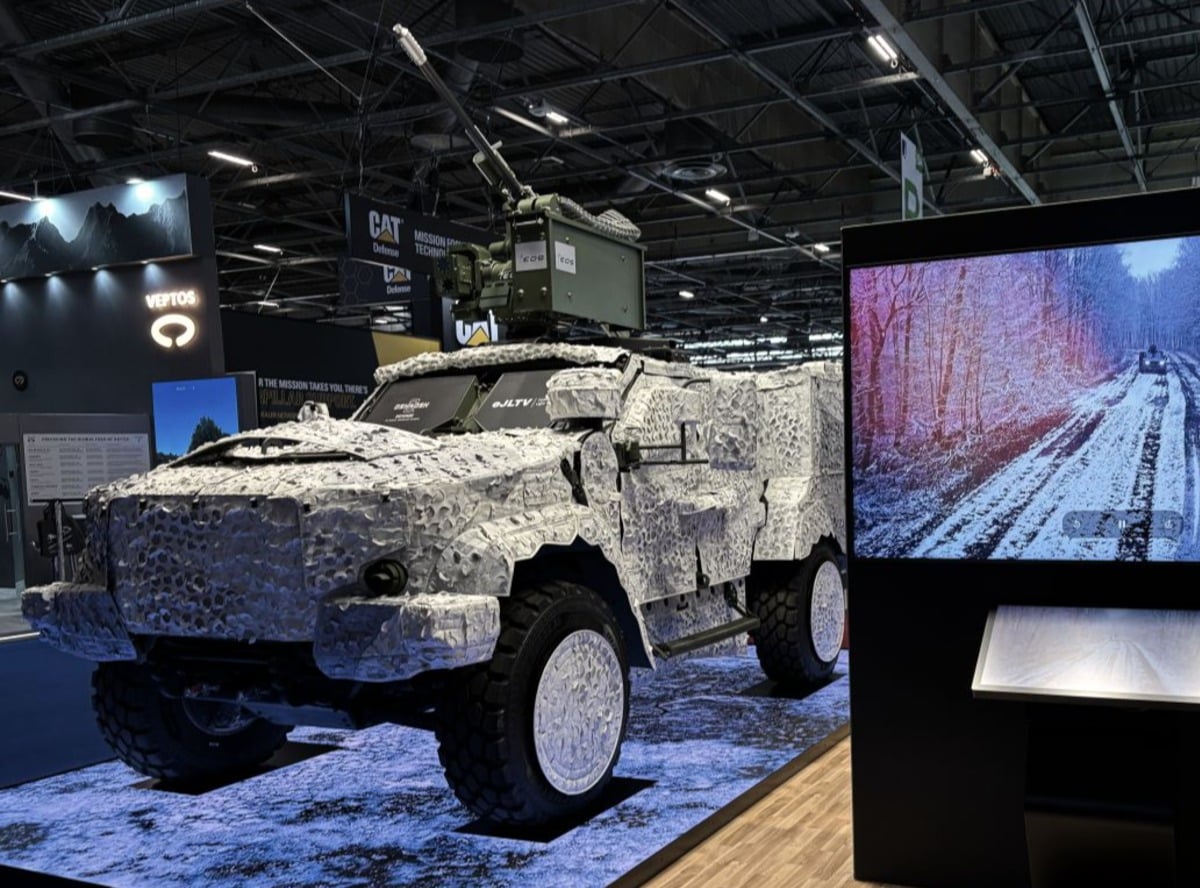
More than 24,000 JLTVs have been produced, according to Oshkosh Defense, making the Joint Light Tactical Vehicle one of the more widely fielded U.S.-made light tactical vehicles among American and allied forces, and the Wisconsin-based defense manufacturer chose Eurosatory 2026 in Paris this week to show European customers what a hybrid-electric JLTV demonstrator can do: run quietly enough to conduct surveillance operations without announcing its presence, generate enough onboard electrical power to run next-generation battlefield electronics, and extend its operational range beyond what a conventional combustion drivetrain allows, while using the existing JLTV platform as the basis for a demonstrator that avoids the risk and development timelines of an entirely new vehicle program.
The hybrid-electric JLTV, which Oshkosh designates the eJLTV, is the centerpiece of the company’s appearance at the USA Pavilion, Booth A320 at Eurosatory 2026, and it represents a specific strategic argument that the company is making to NATO allies accelerating their modernization programs under real operational pressure.
The JLTV itself requires some context for any reader who has not followed American military vehicle procurement over the past decade, because it is a more consequential platform than its relatively modest profile in mainstream news coverage suggests. Developed to replace the aging High Mobility Multipurpose Wheeled Vehicle, universally known as the Humvee, which proved dangerously vulnerable to improvised explosive devices in Iraq and Afghanistan, the JLTV entered full-rate production in 2019 after a development program that selected Oshkosh over competing designs from Lockheed Martin and AM General. The vehicle weighs approximately 6,350 kg (14,000 lb) in its base configuration, seats four crew members, carries a payload of around 1,587 kg (3,500 lb), and provides significantly better protection than the Humvee it replaces against blast threats, small arms fire, and overhead fragmentation, while maintaining the off-road mobility that light tactical vehicles require to operate in terrain that heavier armored vehicles cannot access. The United States Army and Marine Corps are the primary operators, but allies including the United Kingdom, Montenegro, Lithuania, Slovenia, Romania, North Macedonia, and Brazil have also fielded or ordered the platform, giving it the multinational operational footprint that makes a hybrid-electric demonstrator relevant to a European defense audience rather than purely an American domestic development.
The eJLTV variant on display at Eurosatory adds four capabilities to the standard JLTV foundation that are directly relevant to how European and NATO militaries expect future battlefields to function. Silent drive allows the vehicle to operate on electric power alone for movement near enemy positions, eliminating the acoustic signature that combustion engines produce and that adversaries can detect, a capability that has become operationally significant as drone-based reconnaissance makes conventional vehicle noise a genuine targeting vulnerability. Silent watch extends that principle to stationary operations, allowing the vehicle to maintain full electronic systems including radios, sensors, and crew comforts without running the engine, reducing the infrared signature and the audible signature that running engines generate during observation posts or ambush positions. Onboard exportable power generation, meaning the vehicle’s hybrid system can supply electrical power to external devices and systems, addresses the growing demand from soldiers carrying and operating increasingly power-hungry electronics including communications systems, targeting devices, and counter-drone equipment that drain conventional battery systems faster than they can be recharged in the field. Extended range, the fourth capability, results from the hybrid drivetrain’s ability to supplement the combustion engine with electric propulsion during lower-demand phases of movement, reducing fuel consumption and extending the distance a unit can cover before requiring resupply, which directly affects operational reach in contested environments where fuel convoys are themselves targets.
Pat Williams, Chief Programs Officer at Oshkosh Defense, articulated the commercial logic behind bringing the eJLTV to a European audience at this particular moment in terms that address the fundamental tension facing every NATO ally trying to modernize quickly. “European and allied forces are modernizing under real operational pressure, and they also need solutions that can be fielded, sustained and integrated quickly,” Williams said. “The eJLTV demonstrates how Oshkosh Defense can evolve a combat-proven platform to support future power, interoperability and distributed operational requirements without forcing customers to accept the risk and timelines associated with entirely new vehicle programs.”
That argument, that upgrading a proven platform is faster, cheaper, and lower-risk than fielding an entirely new one, carries particular weight in the current European defense procurement environment, where governments are racing to spend rapidly increasing defense budgets but face industrial bottlenecks, long lead times, and the operational reality that soldiers need equipment that works now rather than equipment that will be better in five years. A country that already operates JLTVs, or that operates within coalition structures with JLTV-equipped allies, can integrate the eJLTV concept into existing maintenance infrastructure, draw on the same spare parts supply chains, and train crews who are already familiar with the basic vehicle before they encounter the hybrid-electric system’s additional capabilities. A country procuring an entirely new light tactical vehicle must build all of that support infrastructure from scratch, a process that routinely takes years longer than the vehicle’s development itself.
The eJLTV is currently an advanced capability demonstrator, meaning it is a technically mature vehicle built to demonstrate performance and generate customer interest rather than a system already in full production, and the timeline from demonstrator to fielded capability will depend on customer demand, procurement decisions, and the additional development work required to transition from demonstrator to production configuration.