
Oshkosh Shows Expeditionary Power with ship-killing Drone Truck at Marine Expo
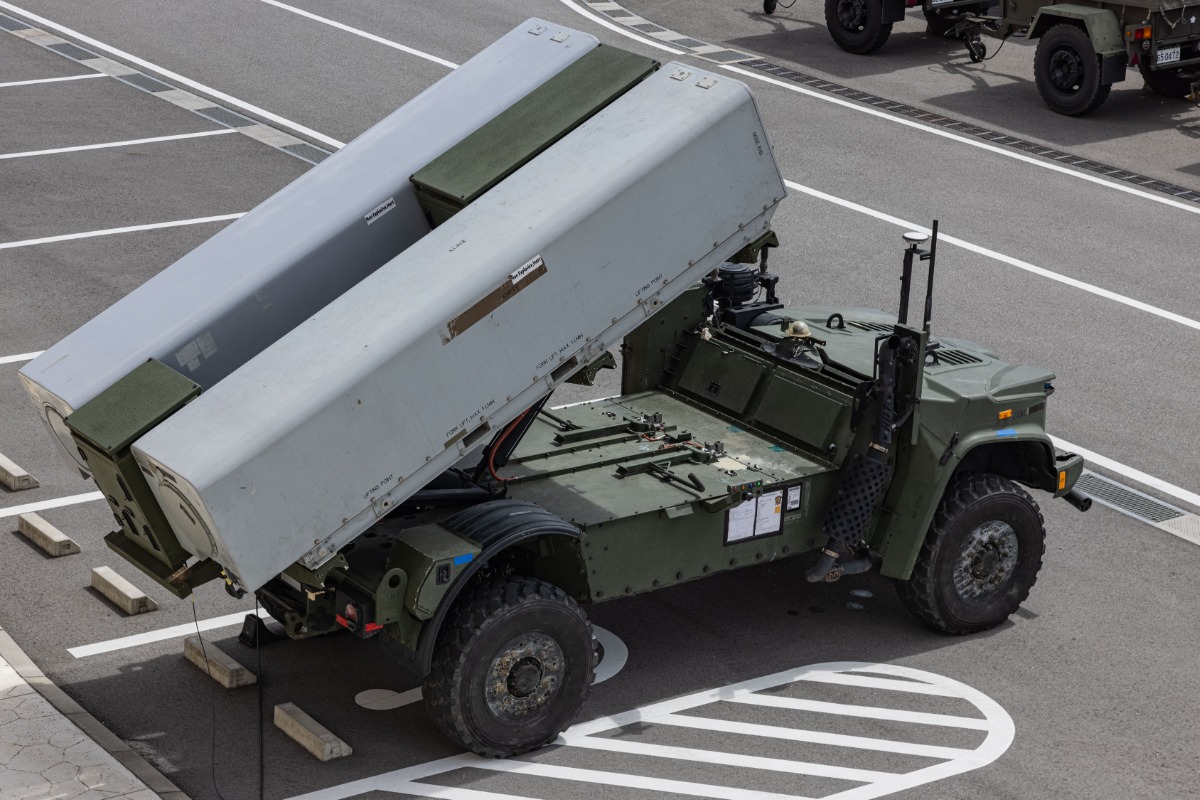
Oshkosh Defense is rolling two significant platforms onto the Modern Day Marine exhibition floor this week — including an autonomous ground vehicle armed with anti-ship missiles that represents one of the Marine Corps’ most consequential doctrinal shifts in a generation.
The company will exhibit at Modern Day Marine from April 28 through 30, 2026, showcasing the Remotely Operated Ground Unit for Expeditionary Fires, known as ROGUE-Fires, alongside an upgraded variant of the Medium Tactical Vehicle Replacement. Both platforms speak to the same underlying Marine Corps priority: the ability to disperse, move, and sustain combat power across contested maritime environments without concentrating forces in ways that make them easy targets.
ROGUE-Fires is the more operationally striking of the two. Built on Oshkosh’s Joint Light Tactical Vehicle platform — the JLTV, already the Marine Corps’ primary light protected vehicle — it carries the Navy/Marine Expeditionary Ship Interdiction System, or NMESIS, which is itself the launch vehicle for the Naval Strike Missile. The result is a ground-based, autonomously operated platform that can fire anti-ship missiles from coastal terrain, deny adversary naval forces access to contested waterways, and then move before an enemy can locate and engage it. ROGUE-Fires has no one in the cab. Marines operate it remotely, which means the vehicle can be pushed forward into positions where the risk of direct fire, counter-battery, or air attack would make a crewed vehicle too costly to employ.
The sea denial mission ROGUE-Fires supports is central to how the Marine Corps intends to fight in a high-end Pacific conflict. The Force Design 2030 concept that has reshaped Marine Corps structure and doctrine over the past several years is built around the idea of small, dispersed units operating from islands and coastal terrain, using anti-ship missiles and other long-range fires to shape the maritime environment and support naval campaigns. A ground-launched anti-ship missile system that can be positioned, fired, and relocated without exposing a crew to direct risk is exactly the kind of capability that concept requires. The JLTV platform underneath ROGUE-Fires provides the mobility to move across the austere terrain those island positions typically offer — unpaved tracks, beaches, jungle edges — while the autonomous operation capability allows the vehicle to be employed in places and postures that would be operationally untenable for a crewed system.
The Naval Strike Missile, which NMESIS carries, is a long-range precision anti-ship weapon developed by Kongsberg and Raytheon. It flies a sea-skimming profile at extended range, uses terrain-following navigation in its approach phase, and carries an active radar seeker for terminal homing. Its combination of range, precision, and low flight profile makes it difficult to intercept and capable of threatening surface combatants well beyond visual range. On a ground vehicle that can be repositioned rapidly and operated remotely, those characteristics translate into a coastal defense and sea denial capability that does not require a ship or aircraft to deliver — and that is survivable in a way that fixed coastal missile batteries are not.
The second platform Oshkosh is displaying at Modern Day Marine is less dramatic but arguably just as operationally important. The MTVR 4×4 — Medium Tactical Vehicle Replacement — is the Marine Corps’ primary medium logistics truck, a platform that has been hauling ammunition, fuel, water, food, and equipment across every operational environment the Corps has operated in for decades. The variant on display comes equipped with exportable power and enhanced lighting, upgrades that extend what the vehicle can do beyond pure cargo hauling. Exportable power allows the MTVR to serve as a mobile power source for forward units, feeding communications equipment, sensors, command post systems, and other electrical loads without requiring a separate generator. Enhanced lighting extends the vehicle’s operational utility in low-light and nighttime environments, which matters for logistics operations that increasingly need to move at night to avoid aerial observation and attack.
Those may sound like incremental improvements, but for a logistics vehicle that forms the backbone of Marine Corps ground sustainment, they represent meaningful capability additions. Distributed operations of the kind Force Design 2030 envisions place enormous stress on logistics — small units operating from dispersed positions across island terrain cannot rely on centralized supply points the way conventional formations do. They need organic power generation, the ability to operate at night, and vehicles that can navigate austere terrain to reach positions that heavier trucks cannot access. The MTVR 4×4’s upgrades push it further in each of those directions while, as Oshkosh notes, extending the platform’s service life rather than requiring a wholesale replacement.
Pat Williams, Chief Program Officer at Oshkosh Defense, framed the company’s approach in terms that bridge both platforms: “Mobility enables how Marines fight and sustain combat power forward, and Oshkosh brings that capability to every platform we deliver. We develop robust, versatile platforms and provide the lifecycle support needed to keep them ready, relevant, and effective in contested environments. From autonomous fires to modernized mobility and integrated sustainment, our approach connects capability with long-term performance in the field.”
Modern Day Marine, held annually in the Washington D.C. area, is the Marine Corps’ primary exposition for industry to present capability to service leadership, acquisition officials, and operators. Oshkosh Defense is in booth 2307. The proximity of ROGUE-Fires and the upgraded MTVR on the same exhibition floor reflects a procurement reality the Marine Corps lives with constantly: winning a high-end maritime fight requires both the ability to threaten enemy ships with precision missiles and the ability to keep the force fed, fueled, and powered in the austere locations from which those missiles are fired. Neither capability is sufficient without the other, and Oshkosh is making the case that it can deliver both.