
Rheinmetall Receives first Order for a Modular Camp Under the German Armed Forces Contractor Augmentation Program II – Static Accommodation in Lithuania
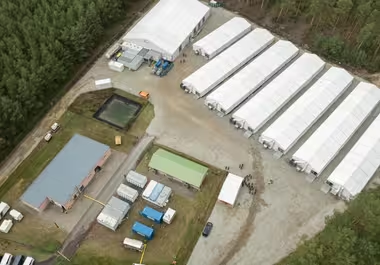
Rheinmetall has received an initial call-off from the Federal Office of Bundeswehr Infrastructure, Environmental Protection and Services (BAIUDBw) under the German Armed Forces Contractor Augmentation Program II – Static Accommodation (G-CAP II SU). In Lithuania, the group will now, as the main contractor, build a modular camp for up to 2,000 soldiers, which is due to become operational from mid-August 2027. Following commissioning, Rheinmetall will be responsible for facility management, including laundry, as well as catering. The order value for the construction of the modular facility amounts to €250 million, while the subsequent operation is valued at €40 million annually. The order was booked in Q3/2026.
The G-CAP II SU programme provides static accommodation for soldiers during deployment and standby commitments in the context of international crisis management and national and collective defence, irrespective of the climatic, geographical and geological conditions in the country of deployment. Pre-planned modular infrastructure covered by the framework agreement, from manufacture through transport, construction and operation to dismantling, forms the core of G-CAP II SU. Since these steps are standardised and can be called off from a single contractor, the entire process is accelerated. In this case, the contract was used to support the Bundeswehr in fulfilling its mission in Lithuania.
The G-CAP II SU project, initiated by BAIUDBw, aims to enable private-sector service providers to provide static accommodation during deployment. By enabling the private sector to establish such infrastructure, the Bundeswehr can conserve its own resources and keep them available for high-threat situations.
Rheinmetall is responsible for the planning, manufacturing and delivery of camps worldwide – by sea, land or air as required – as well as their construction, multi-year autonomous operation and subsequent dismantling