


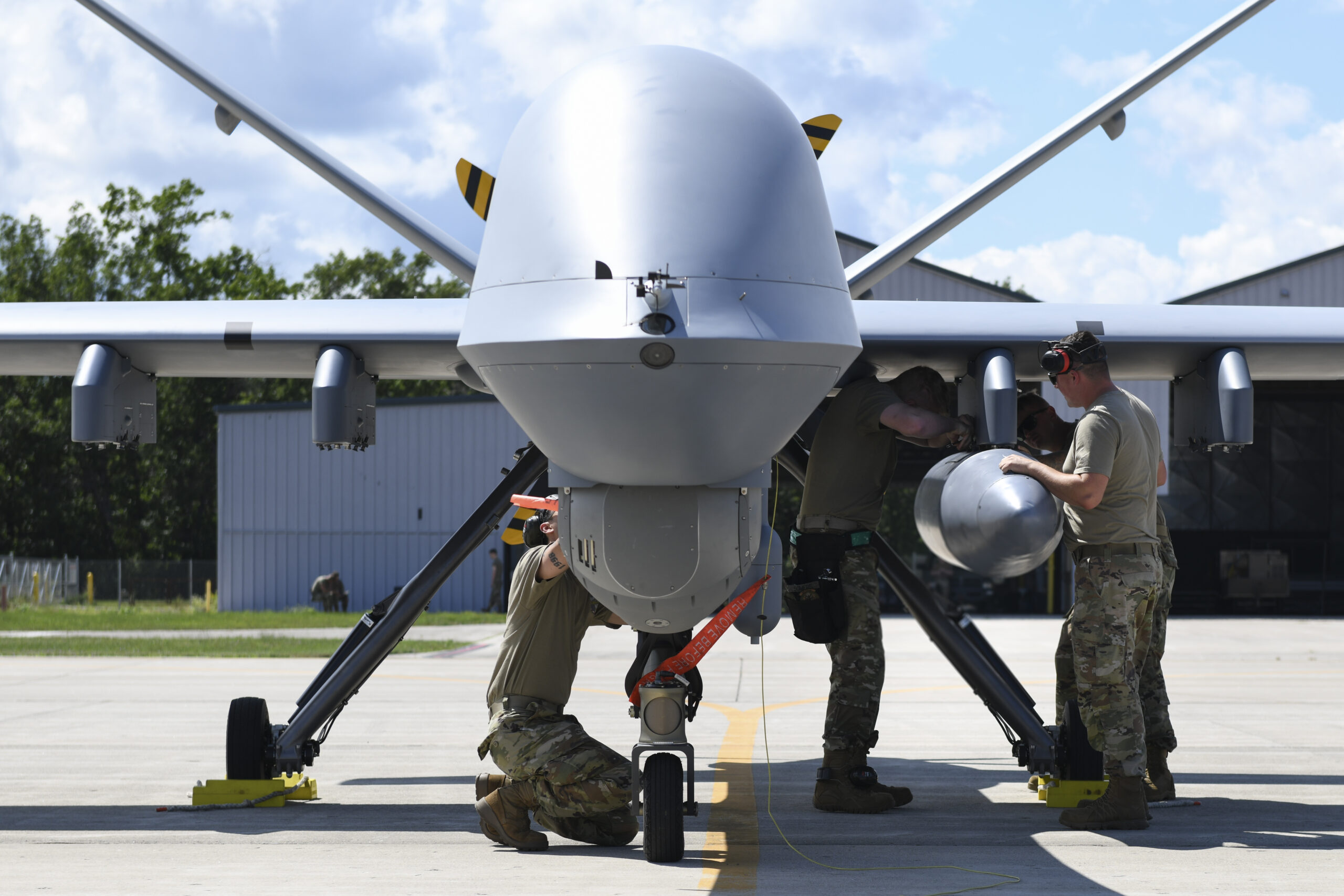
U.S. Air Force Tests Electromagnetic Attack pod on Drone
BAE Systems confirmed on February 23, 2026, that it successfully demonstrated a scaled modular electromagnetic attack (EA) system during multiple flight test events conducted in collaboration with the United States Air Force, using a prototype mounted in a weapon pod on a test aircraft representing a Group 4 or Group 5 unmanned aerial vehicle.
The testing comes as military planners seek new ways to counter increasingly networked battlefield systems that rely on the electromagnetic spectrum for coordination, targeting, and communications. Distributed electronic attack capabilities are intended to complicate enemy sensing and command functions without relying solely on large, specialized aircraft.
According to BAE Systems, the prototype system demonstrated the ability to generate scalable electromagnetic effects using compact hardware derived from existing airborne EA weapon systems. The company said the smaller configuration allows electronic attack capabilities to be deployed across multiple platforms rather than concentrated on a limited number of high-end aircraft.
The demonstration was carried out with participation from the United States Air Force and additional partner organizations. During the tests, the modular EA payload operated inside a weapon pod installed on a surrogate aircraft designed to represent operational unmanned aerial vehicles in the Group 4 and Group 5 categories, which typically include medium- and high-altitude long-endurance systems.
“We’re showing the armed services that we can scale down our high-performance EA hardware and repurpose it for smaller nodes on the network,” said Rory Duddy, program director for Modular Electromagnetic Attack at BAE Systems. “We’re innovating to deliver a cost-efficient mix of exquisite and affordable capabilities that work together to deliver a discriminating effect on the battlespace.”
As noted by the company, the system runs proven counter-C5ISRT software designed to disrupt command, control, communications, computing, cyber, intelligence, surveillance, reconnaissance, and targeting networks. The demonstration also incorporated a third-party software application, highlighting compatibility with externally developed electronic warfare tools.
BAE Systems said the modular EA system is built using core components from its existing high-power airborne electronic attack technologies, which are already used for counter-C5ISRT missions. By reusing these building blocks, the company aims to provide lower-cost electronic warfare options that can be fielded more broadly across operational units.
Technically, electromagnetic attack systems work by emitting controlled electronic signals that interfere with an adversary’s ability to transmit data, detect targets, or coordinate forces through radar and communications networks. Rather than physically destroying targets, EA systems degrade or deny access to the electromagnetic spectrum, which modern militaries depend on for battlefield awareness.
The modular architecture allows the system to be configured according to platform size, available electrical power, and mission requirements. According to BAE Systems, the payload can be integrated into weapon pods or adapted for collaborative combat aircraft, unmanned aerial systems, rotary-wing aircraft, ground vehicles, surface vessels, and remotely operated weapon stations.
The company stated that the system can operate independently to deliver targeted counter-C5ISRT effects or complement larger electronic warfare platforms such as the U.S. Air Force’s EA-37B electromagnetic attack aircraft. This layered approach enables distributed electronic warfare operations where multiple smaller systems operate simultaneously across the battlespace.
BAE Systems also emphasized that its EA mission systems rely on open architecture hardware and software-defined radios, allowing rapid updates and integration of new capabilities. The system is compliant with Software Open Systems Architecture (SOSA) standards and aligned with Big Iron technical standards, enabling faster capability insertion and compatibility with commercial technologies.