


U.S. Marine Corps Awards new ROGUE-Fires Missile Carrier Deal
The United States Marine Corps has awarded Oshkosh Defense LLC a $16,8 million contract modification supporting procurement of Remotely Operated Ground Unit for Expeditionary Fires (ROGUE-Fires) carriers used in the Navy and Marine Expeditionary Ship Interdiction System, according to an official contract announcement released Feb. 20, 2026.
The work will be performed across multiple U.S. locations with completion expected by December 2026.
The modification supports continued fielding of autonomous ground-based missile launch platforms designed to provide expeditionary forces with long-range precision strike capability against maritime targets. The ROGUE-Fires system is central to the Marine Corps’ effort to deploy mobile anti-ship weapons capable of operating from dispersed coastal positions.
According to the contract notice, Oshkosh Defense, based in Oshkosh, Wisconsin, will conduct work primarily in Oshkosh (60%), with additional work performed in Gaithersburg, Maryland (20%), Alexandria, Virginia (10%), and Pittsburgh, Pennsylvania (10%). Marine Corps Systems Command in Quantico, Virginia, serves as the contracting activity under contract number M67854-22-F-1005-P00008.
Fiscal Year 2026 Marine Corps procurement funds totaling $12,270,247 and research, development, test and evaluation funds totaling $4,588,459 were obligated at the time of the modification and will not expire at the end of the current fiscal year. The action was executed as a negotiated modification to an existing delivery order in accordance with Title 10 U.S. Code 3403(c).
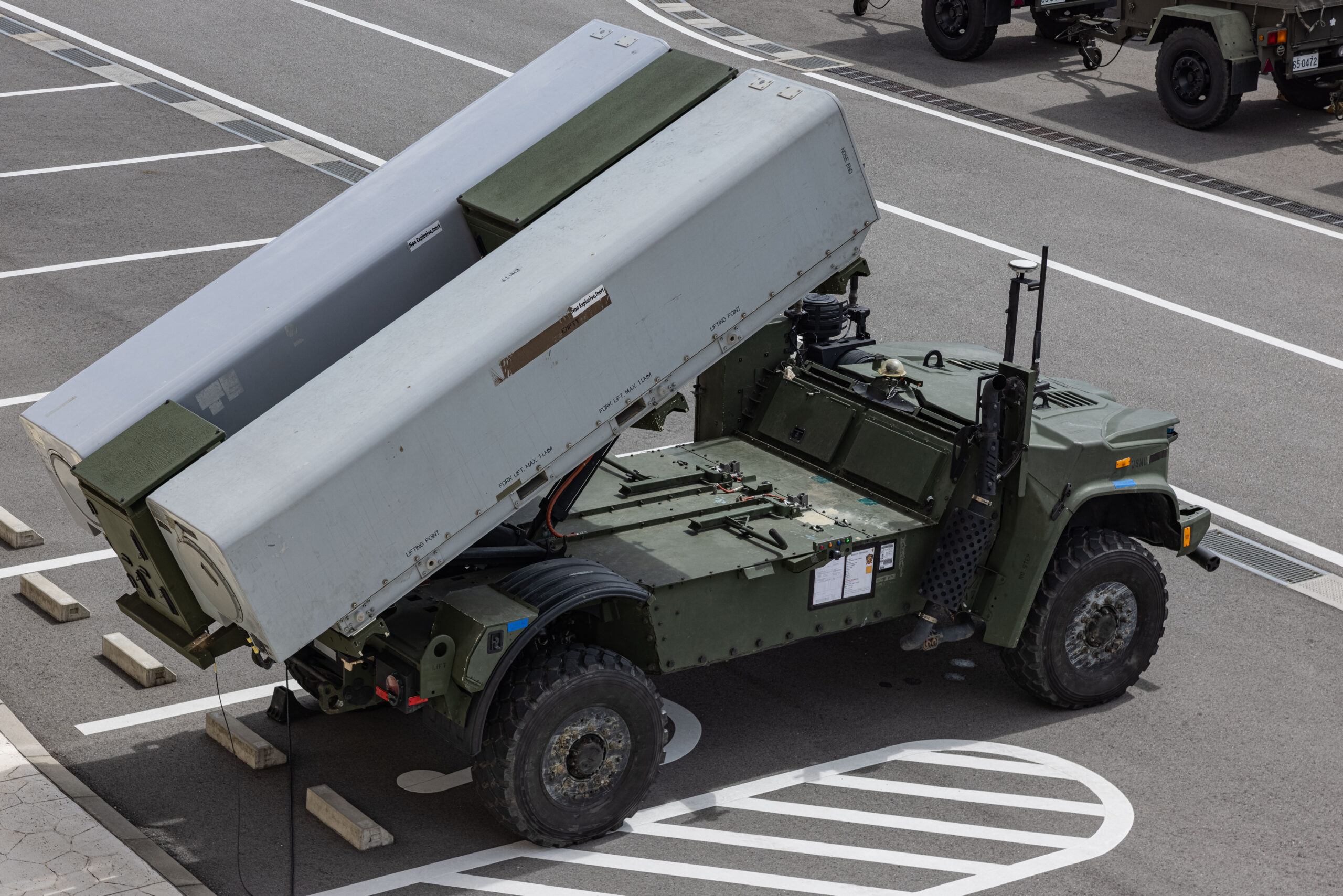
The procurement focuses on the Remotely Operated Ground Unit for Expeditionary Fires, commonly known as ROGUE-Fires, a payload-agnostic platform designed to operate without onboard personnel. The system is transported using the Joint Light Tactical Vehicle (JLTV) chassis, which has been modified by removing the crew cab and integrating a missile launch system to create an unmanned mobile firing platform.
In operational terms, ROGUE-Fires enables Marine units to deploy long-range strike weapons while reducing risk to personnel. The autonomous launcher can be remotely operated and repositioned, allowing forces to fire missiles and relocate without exposing crews to counterfire. The platform is also designed to support autonomous resupply and logistics operations in expeditionary environments.
The system has been configured to carry the Naval Strike Missile, a precision-guided anti-ship weapon intended to engage surface vessels at extended ranges from land-based launch sites. According to program descriptions, the launcher can also accommodate a single Tomahawk cruise missile loaded within a standardized launch canister, expanding the range of potential mission profiles.
The Navy and Marine Expeditionary Ship Interdiction System integrates ROGUE-Fires launchers into a broader concept aimed at denying adversary naval forces access to contested maritime areas. By deploying mobile missile batteries across islands or coastal terrain, Marine units can establish distributed firing positions capable of targeting ships without relying on traditional naval platforms.
The development reflects the Marine Corps’ ongoing shift toward expeditionary advanced base operations, a concept emphasizing smaller, mobile units equipped with long-range precision weapons. Autonomous systems such as ROGUE-Fires allow forces to maintain combat presence while minimizing logistical footprint and personnel exposure.
Previous testing and exercises have demonstrated the ability of unmanned launchers to operate alongside reconnaissance networks and targeting sensors, enabling coordinated long-range fires from dispersed positions. The integration of unmanned platforms into missile forces represents a broader trend toward automation in ground-based strike systems.