
U.S. Navy Awards $154M for 11 F-35s Bound for Undisclosed Customer
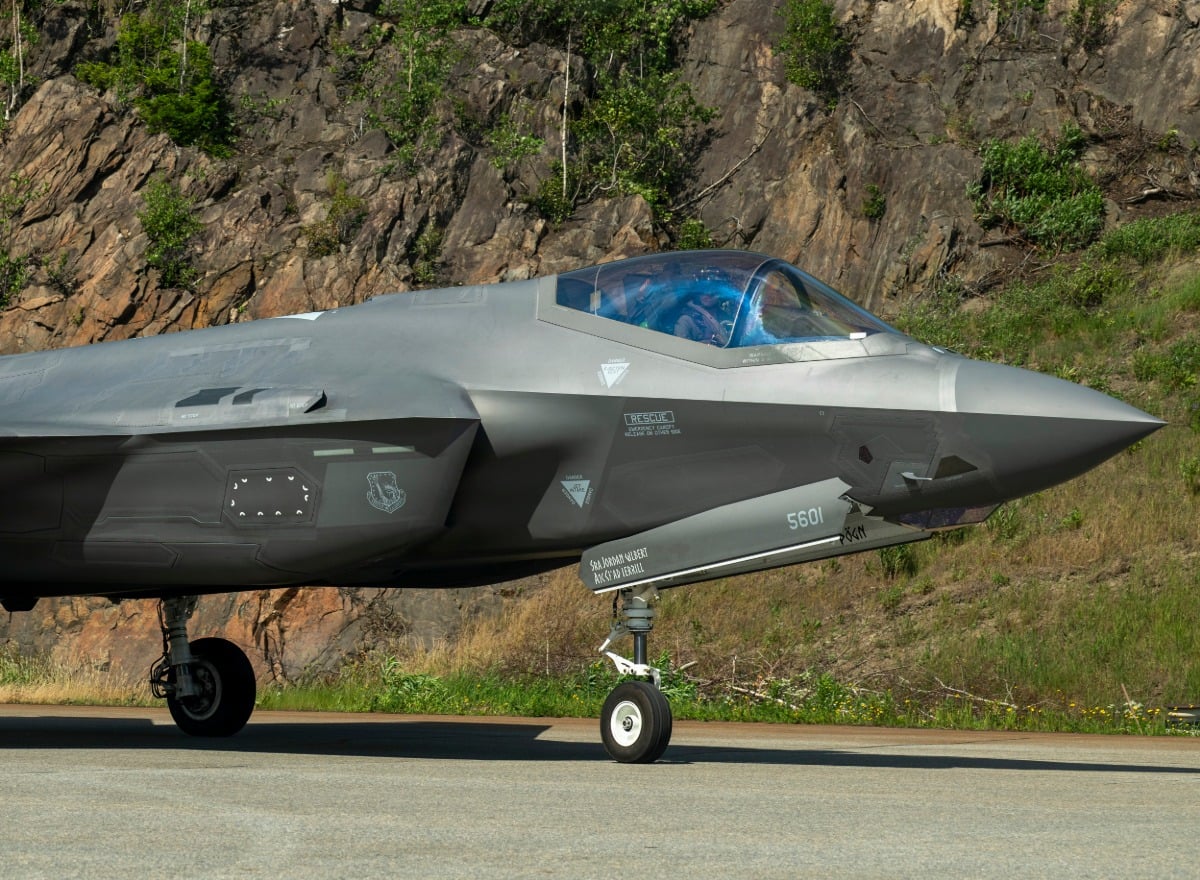
The U.S. Navy has awarded Lockheed Martin $154 million to begin purchasing the long-lead components needed to build 11 F-35 stealth fighters for a foreign government whose identity the Pentagon has not disclosed, adding another batch of the world’s most widely sold combat aircraft to an order book that spans more than a dozen nations.
The contract modification, awarded to Lockheed Martin Aeronautics in Fort Worth, Texas, covers long-lead materials, parts, and components for 11 F-35 Lightning II aircraft destined for a Foreign Military Sales customer. Long-lead procurement, the practice of ordering parts with extended manufacturing timelines before the main production contract is formally placed, is standard practice in F-35 acquisition because certain components, particularly advanced electronics, engine components, and specialized composite structures, take years to manufacture and must be ordered well ahead of assembly to avoid delays. The work is expected to complete in December 2030, which gives a rough indication of when these aircraft might be approaching delivery, though final aircraft delivery timelines typically run past initial component completion dates.
The F-35 Lightning II comes in three variants: the F-35A conventional takeoff and landing version used by air forces, the F-35B short takeoff and vertical landing version used by the Marine Corps and several allied navies, and the F-35C carrier variant operated by the U.S. Navy. All three variants share a common design baseline and many systems, but differ structurally for conventional, short takeoff and vertical landing, and carrier operations. The F-35B, for example, incorporates a Rolls-Royce LiftSystem driven by the Pratt and Whitney F135 engine, a configuration unique to that variant that allows it to hover and land vertically. All three variants carry the same AN/APG-81 active electronically scanned array radar, the AN/AAQ-40 electro-optical targeting system, and the AN/ASQ-239 electronic warfare suite that collectively give the aircraft its ability to detect, track, and engage targets across multiple domains simultaneously. More than 1,300 F-35s have been delivered to date, with more than 3,400 aircraft planned across current and future customers.
The customer was identified only as a Foreign Military Sales customer, and the contract announcement did not name the country. Under the Foreign Military Sales system, foreign governments purchase American military equipment through the U.S. government as an intermediary, with the Navy’s Naval Air Systems Command at Patuxent River, Maryland, serving as the contracting activity that manages the transaction. The contracting structure means Lockheed Martin deals with the U.S. government as its customer even though the aircraft will ultimately fly for a foreign air force, which simplifies the legal and security framework governing the production and export of a classified stealth aircraft.
The work distribution across the contract provides some geographic insight into how F-35 production is structured. Fort Worth, Texas, at 59 percent of the work, is the primary final assembly and checkout facility where all F-35 variants come together from their component suppliers. El Segundo, California, at 14 percent, reflects Northrop Grumman’s center section manufacturing work and the activity of other key subcontractors in the greater Los Angeles aerospace cluster. Warton in the United Kingdom, at 9 percent, is BAE Systems’ facility responsible for aft fuselage and other structural components. Cameri in Italy, at 4 percent, is Leonardo’s facility which serves as both a production site and the final assembly and checkout location for European-delivered aircraft. The remaining percentages spread across Orlando, Nashua, Baltimore, San Diego, and various locations outside the continental United States, reflecting the deliberately international supplier base that was built into the program to create political and industrial support across partner nations.
The $154 million obligation attached to this modification is foreign military sales funding, meaning the money comes from the purchasing government rather than the U.S. defense budget. This contract action was not competed, consistent with standard F-35 practice where Lockheed Martin is the sole producer of the airframe and the only entity capable of managing production for a given lot of aircraft.
The F-35’s sustained foreign demand reflects a strategic alignment that goes beyond the aircraft’s technical performance. Nations that buy F-35s gain access to the Link-16 and Multifunction Advanced Data Link communications systems that allow F-35s to share sensor data with each other and with other NATO-compatible platforms in real time, creating a networked air picture that single-platform sensors cannot replicate. An F-35 pilot can see what every other F-35 in the formation sees, plus what legacy radar aircraft and ground sensors are seeing, without broadcasting the aircraft’s own position. That networking advantage is as significant as the stealth, and it is one reason governments continue to queue for the aircraft even as its per-unit cost remains among the highest in the world for a tactical fighter.