


UK Firm Develops AI-powered Autopilot for Unmanned Systems
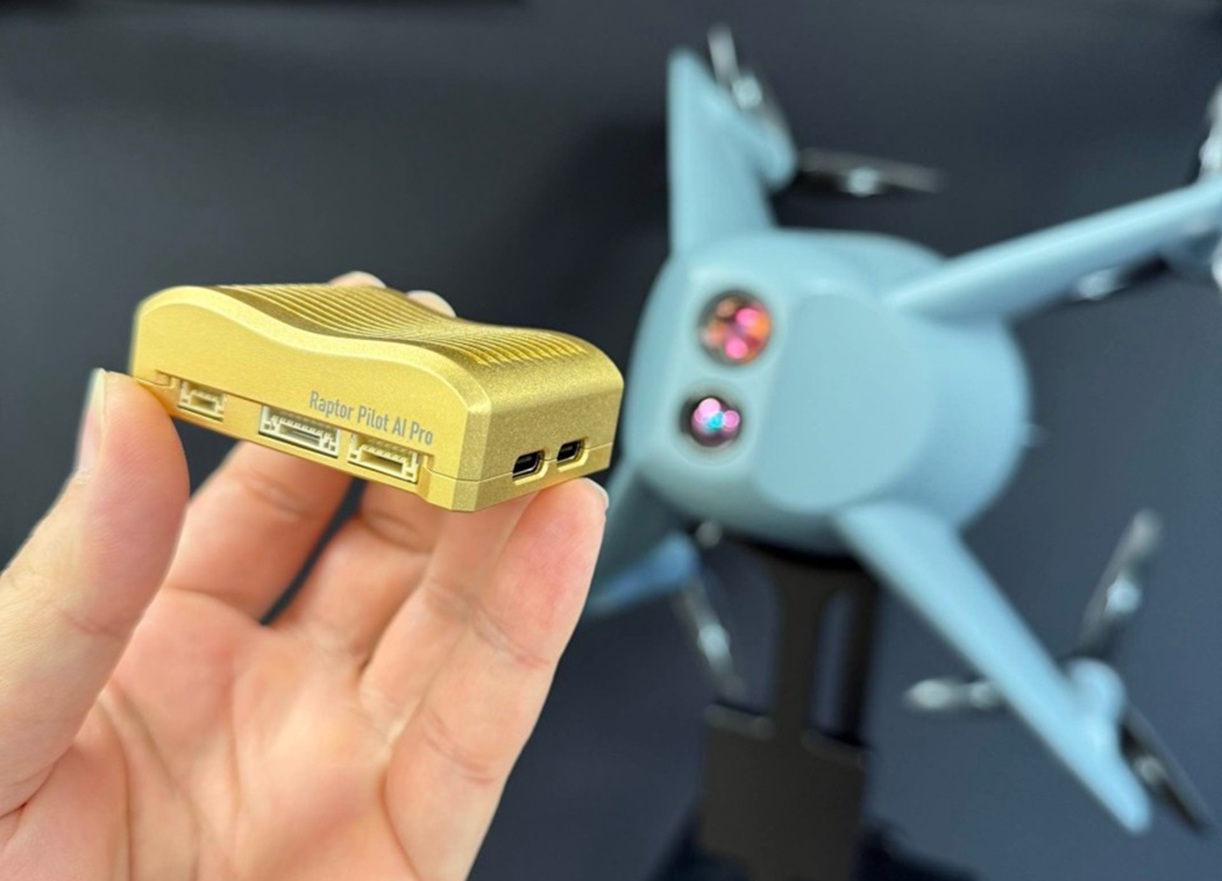
London Defence R&D publicly revealed its new Raptor Pilot AI Pro system at the World Defense Show, presenting the platform as an AI-powered autopilot designed for unmanned aerial vehicles and robotic systems, the company said.
The unveiling marked the first public presentation of its latest developments, including Raptor Pilot AI Pro and the Raptor XL interceptor drone, during the international defense exhibition. The company positioned the system as a unified onboard solution combining flight control, guidance, and artificial intelligence processing in a single compact module.
London Defence R&D founder Aytekin Guclu said: “Raptor Pilot AI Pro is an AI-powered drone autopilot that transforms any class of unmanned aerial vehicle into intelligent precision munition. By fusing a high-performance vision processing computer with a full flight control system, it delivers the world’s smallest yet most powerful unified autopilot architecture engineered for speed, autonomy, and decisive impact.”
The company stated that Raptor Pilot AI Pro uses a unified architecture that integrates flight control, guidance, and onboard AI processing on one module, removing the need for a separate companion computer. Core computing is based on a quad-core CPU operating at 2.4 GHz, with integrated on-screen display support as part of the single-unit system.
Flight control hardware is built around an STM32F405 flight controller, supporting high-rate real-time stabilization and control loops. The module incorporates an integrated inertial measurement unit and barometer to provide precise attitude and altitude estimation during autonomous operation, according to London Defence R&D.
For vision and autonomy, the system processes full-HD video at 1920×1080 resolution at 30 frames per second. London Defence R&D said onboard AI enables real-time object detection, object tracking, and vision-aided navigation and guidance. The architecture is designed to support multiple cameras for different mission configurations.
Raptor XL
Navigation and guidance functions rely on sensor fusion combining visual data, inertial measurements, barometric inputs, and GNSS-assisted positioning. The company stated that the system is designed to operate in challenging environments, including conditions with degraded satellite navigation signals.
Raptor Pilot AI Pro provides a broad range of interfaces for payload, sensor, and command-and-control integration, including I2C, Ethernet, CAN, UART, PWM, USB, Wi-Fi, and Bluetooth 5.0. London Defence R&D said this allows integration with sensors, effectors, and external control systems without additional onboard computing hardware.
The system operates on an input voltage range of 6 to 28 volts DC and is optimized for unmanned aerial and robotic power systems. Physically, the module measures approximately 4 × 5 × 2 centimeters, weighs about 100 grams, and carries an IP65 rating for operation in harsh environments, according to company specifications.
London Defence R&D stated that Raptor Pilot AI Pro is platform-agnostic and compatible with fixed-wing, multirotor, and hybrid UAVs, interceptor drones, loitering munitions, and ground robotic platforms. The company said the modular design is intended to support integration across multiple unmanned mission types.