
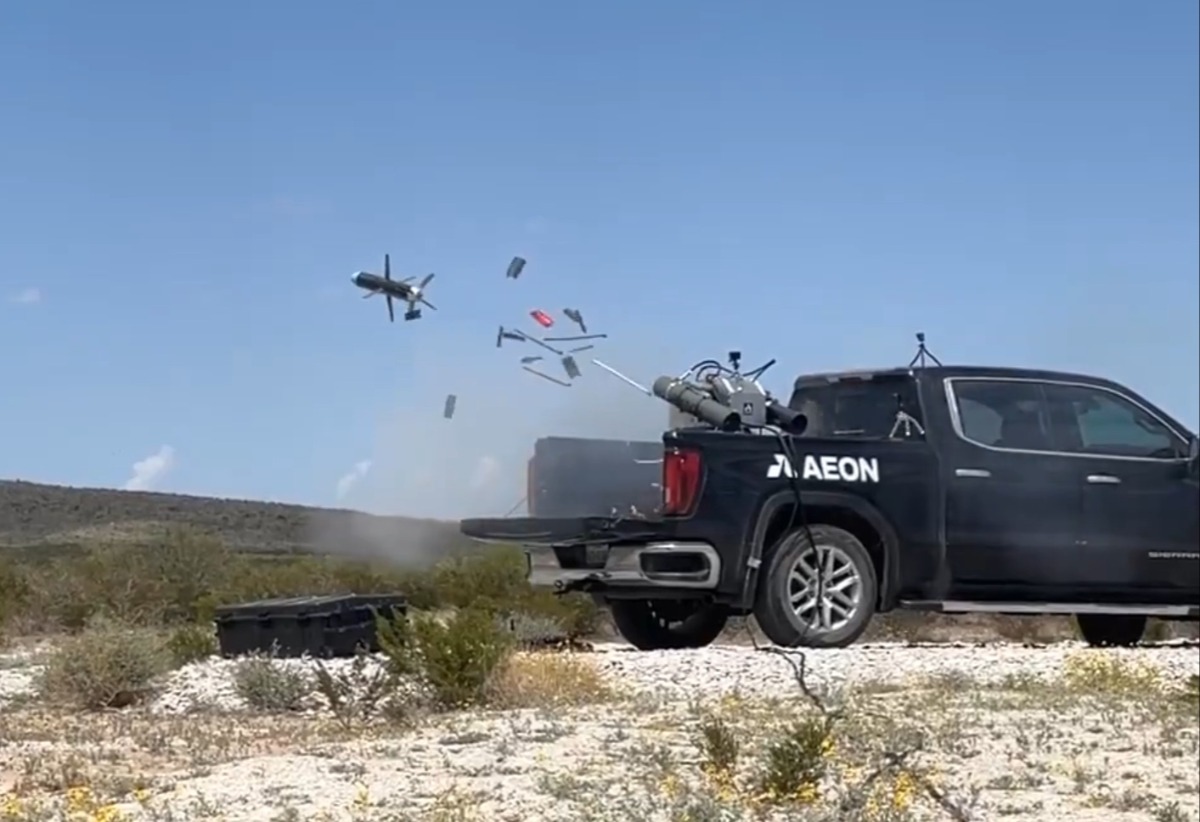
Austin-based defense startup Aeon has carried out another successful test of its Zeus advanced tactical weapon system, the company announced, continuing a rapid development cycle that has seen the small firm push its guided mini-missile through repeated build-and-iterate testing rounds.
Aeon founder and CEO Naweed Tahmas confirmed the test in a public statement: “Another day, another missile test. Build, test, iterate fast.”
Tahmas has framed Zeus’s core value proposition around two principles: affordable mass and adaptability. “Aeon produces missile systems built for affordable mass and adaptability,” he stated. “Vertically integrated from rocket motors to fuzes. Have a platform that needs missiles? We’re ready to integrate.” That pitch is backed by an unusually deep degree of in-house manufacturing — the company designs and mixes its own propellant, manufactures its own rocket motors, and produces Zeus’s fuze, flight computers, and control systems entirely without relying on external suppliers.
Zeus itself is a smart mini-missile built around Aeon’s proprietary threat identification and tracking software, ODIN. The system runs on minimal-smoke propellant, supports both shoulder-fire and vehicle-mounted launches, and is compatible with existing military infrastructure including ATAK — the Android-based situational awareness platform widely used by U.S. and allied forces. That interoperability is a deliberate design choice, allowing Zeus to integrate into current operational workflows without requiring new ground infrastructure or platform-specific modifications.
The vertical integration model is central to what makes Aeon’s development pace possible. Where larger defense primes depend on supply chains that can stretch timelines across months or years, Aeon controls every major component of Zeus internally — from propellant chemistry to flight software. That architecture allows the company to test, identify problems, and iterate in a cycle that mirrors the speed of commercial technology development rather than traditional defense acquisition.
Aeon has disclosed a growing portfolio of integration partnerships that extend Zeus across multiple launch platforms. According to information released exclusively to Tectonic, the company has partnered with heavy-lift drone manufacturer Delta Black to integrate Zeus onto a Group 3 unmanned aerial system — platforms defined by the Department of War as weighing between 55 and 1,320 pounds, offering significantly greater range and payload capacity than smaller commercial drones. Aeon has also partnered with defense supplier Moog to fire Zeus from Moog’s turret platform, and with X-Bow Systems to develop new missile designs. Together these arrangements demonstrate the company’s strategy of embedding Zeus simultaneously across a range of delivery architectures rather than optimizing for a single platform.
The broader context for Zeus’s development is a U.S. defense environment increasingly focused on affordable, scalable precision munitions. Peer and near-peer conflicts have demonstrated that access to large volumes of guided weapons — rather than small numbers of expensive ones — can be a decisive factor in sustained combat operations. Zeus is explicitly designed to address that gap, offering guidance, adaptability, and in-house manufacturability at a price point intended to support mass production.
Defence Blog has previously reported exclusively on Aeon’s active integration work with Ukrainian drone operators, underlining the international interest in Zeus as a platform-agnostic guided strike solution.
Aeon’s continued testing cadence signals that the company is on track to advance Zeus toward operational readiness. With multiple platform integrations underway and a fully vertical manufacturing stack already in place, the startup is building the kind of foundation that turns a promising prototype into a fieldable system.