


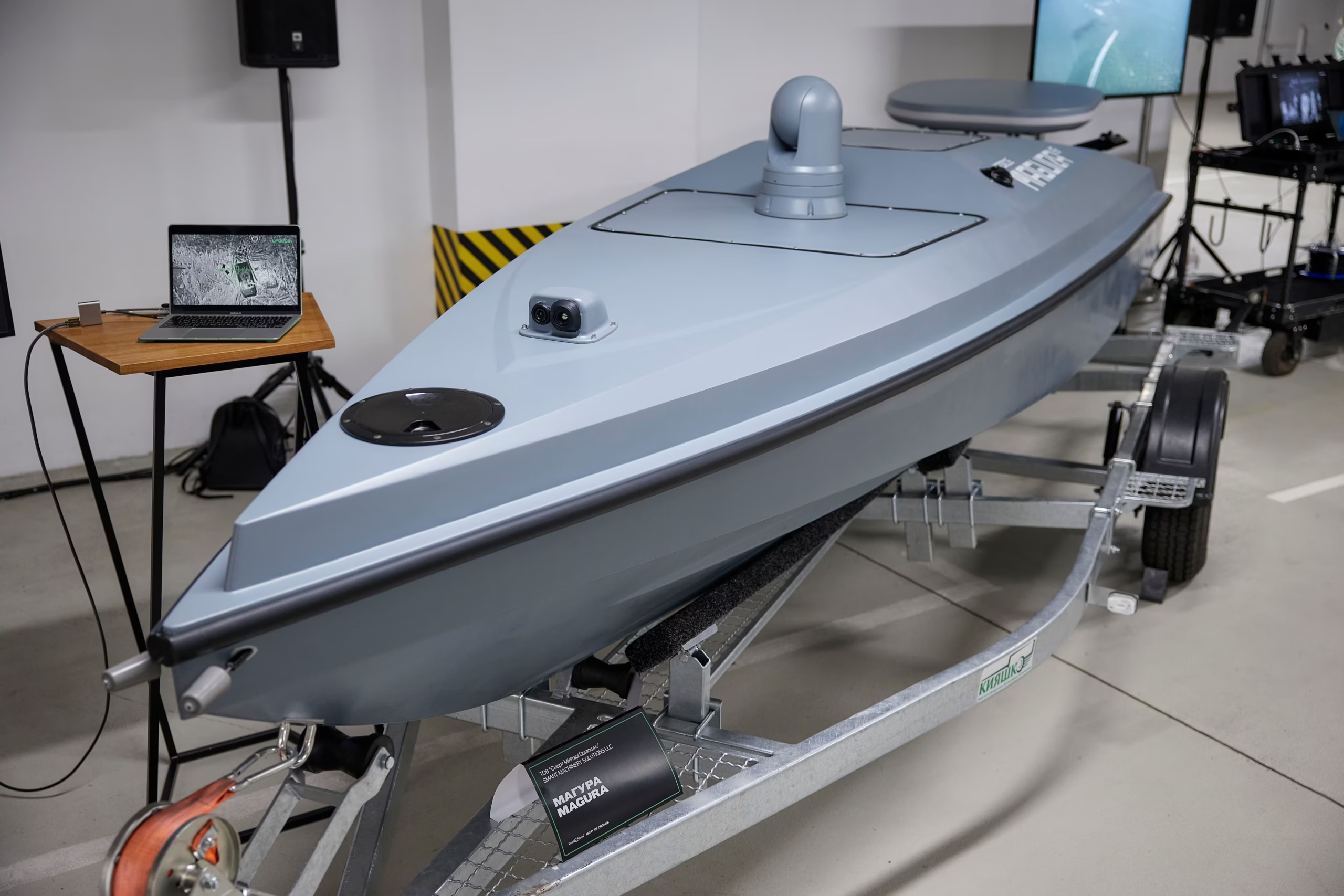
Taiwan to Buy Naval Suicide Drones
The Republic of China Navy (Taiwan) has issued a public request for a naval suicide drone system and associated control infrastructure.
The request, dated December 8, 2025, outlines the Navy’s interest in developing or acquiring unmanned surface vessels (USVs) capable of high-speed, long-range autonomous missions under contested conditions.
According to the notice, the project falls under its national defense innovation initiatives focused on enhancing asymmetric warfare capabilities.
The requested system includes four major components: a suicide unmanned surface vessel, a portable control station, a mobile command vehicle, and a communication relay station. Detailed specifications for each element were outlined in the public announcement.
The suicide USV must be capable of reaching speeds of at least 35 knots and cover a range of at least 250 nautical miles. It should feature autonomous obstacle avoidance, smooth acceleration and deceleration, and operational capacity in sea states of Beaufort scale 4 or higher. The vehicle should weigh no more than 2 tons, carry a payload exceeding 250 kilograms, and have a total length of 6 meters or less.
Taiwan’s Navy also requires that the USV’s navigation system support both GPS and inertial methods, and the platform must be resistant to dust, water, GNSS jamming, and radio interference. The EO/IR payload should allow for real-time image transmission over 24 nautical miles. The control system must support swarming capability and include backup radio links.
For command and control, the portable station should integrate satellite communication, 4G/5G connectivity, main and backup radios, and AES-grade encryption. It must be able to share data with the mobile command vehicle and enable handoff of control authority between platforms.
The mobile command vehicle is required to support operations at distances beyond 24 nautical miles, integrating multiple antenna types, satellite systems, and jamming-resistant communications. The vehicle must also feature onboard power generation, air conditioning, lighting, shock absorption, and a battery backup lasting at least six hours. A touchscreen command panel and hand-held remote control are also included in the required configuration.