


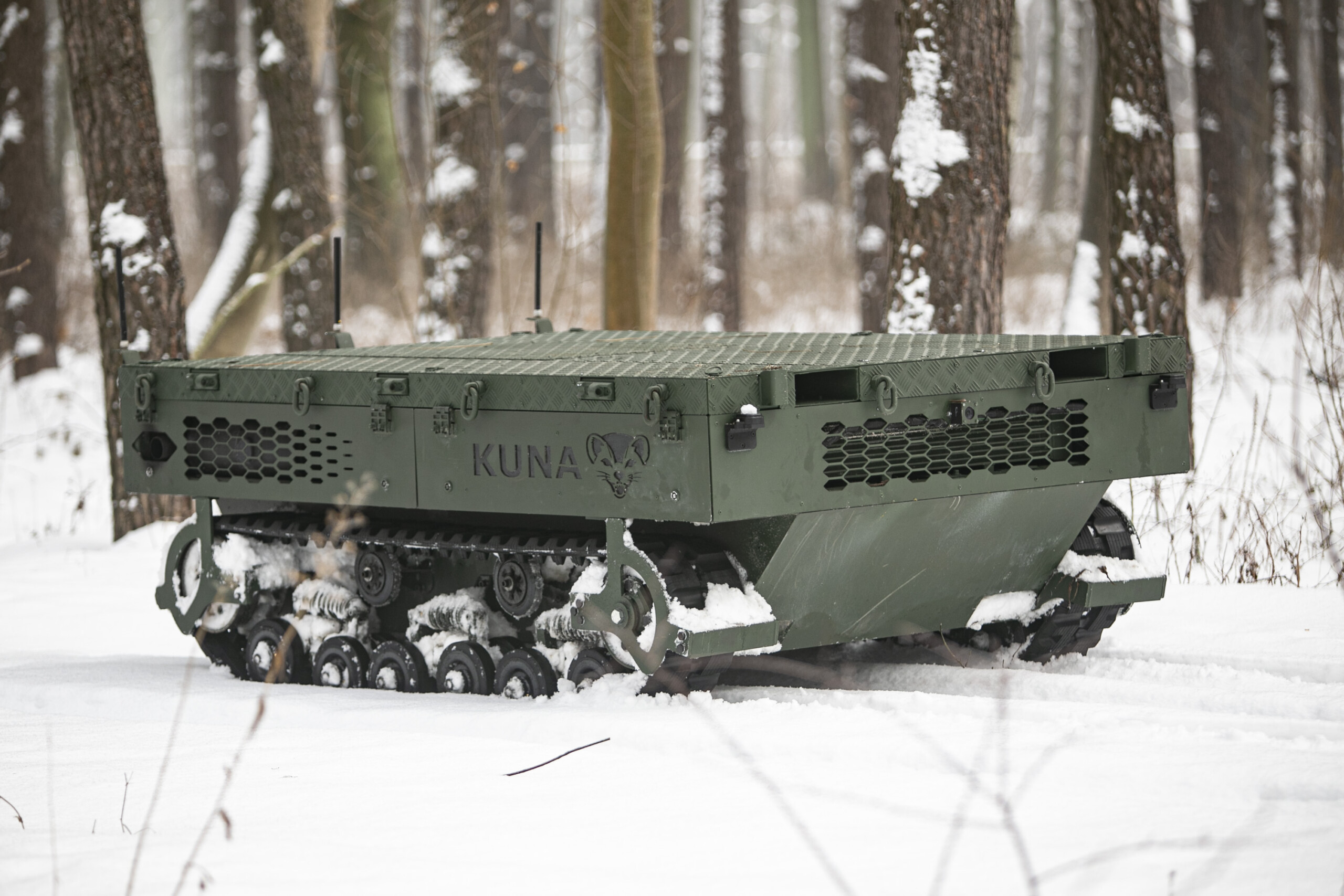
Poland Conducts Winter Trials of KUNA Robotic Vehicle
Poland has tested the KUNA configurable autonomous multi-role platform in winter terrain, confirming its ability to operate in snow, ice, and sub-zero conditions where standard wheeled vehicles lose mobility, according to information released by the Wojskowy Instytut Techniki Pancernej i Samochodowej (WITPiS).
The winter evaluation focused on mobility, autonomy, and logistics support in conditions that typically limit ground operations, including deep snow, ice, and slush. The tests were conducted to verify that the tracked platform can support military units during cold-weather operations, when conventional transport and support vehicles often become immobilized.
KUNA is a tracked autonomous ground platform designed for reconnaissance, logistics, and support missions. Its tracked running gear provides low ground pressure, allowing it to maintain movement over snow-covered and frozen terrain where wheeled vehicles struggle for traction. Developers said this configuration enables sustained maneuvering during winter operations without the need for cleared routes.
According to the project team, KUNA’s autonomy systems allow it to operate in conditions of reduced visibility caused by fog, snowfall, or blizzards. The platform can conduct reconnaissance or supply missions without exposing personnel to harsh weather or enemy observation, making it suitable for operations in isolated or forward positions during winter.
The modular design of KUNA allows rapid reconfiguration for different tasks. During winter trials, the platform was assessed in a logistics support role, where it can deliver ammunition, food, fuel, and medical supplies to units that are difficult to reach by standard vehicles. This capability is intended to support dispersed forces operating in snow-covered or forested terrain.
The platform’s structure was designed using operational experience from the war in Ukraine, where winter conditions have repeatedly affected mobility, sustainment, and evacuation. The design prioritizes mechanical reliability, cold-weather performance, and resistance to environmental stress rather than speed or heavy armor.
KUNA can be operated remotely or in autonomous mode, depending on mission requirements. The autonomy package enables route planning, obstacle avoidance, and movement without GPS, allowing the system to function in environments where navigation signals are degraded or denied.
Tracked autonomous platforms are increasingly being evaluated by European militaries as a way to reduce risk to personnel while maintaining logistics and reconnaissance capacity in difficult terrain. Winter operations remain one of the most demanding scenarios for ground forces, particularly in Eastern and Northern Europe, where snow and ice can halt conventional vehicle movement for extended periods.
The winter trials are part of broader efforts to validate KUNA’s performance across all seasons before potential operational use. No procurement contract has been announced, and Polish defense authorities have not disclosed whether the platform will enter service.