


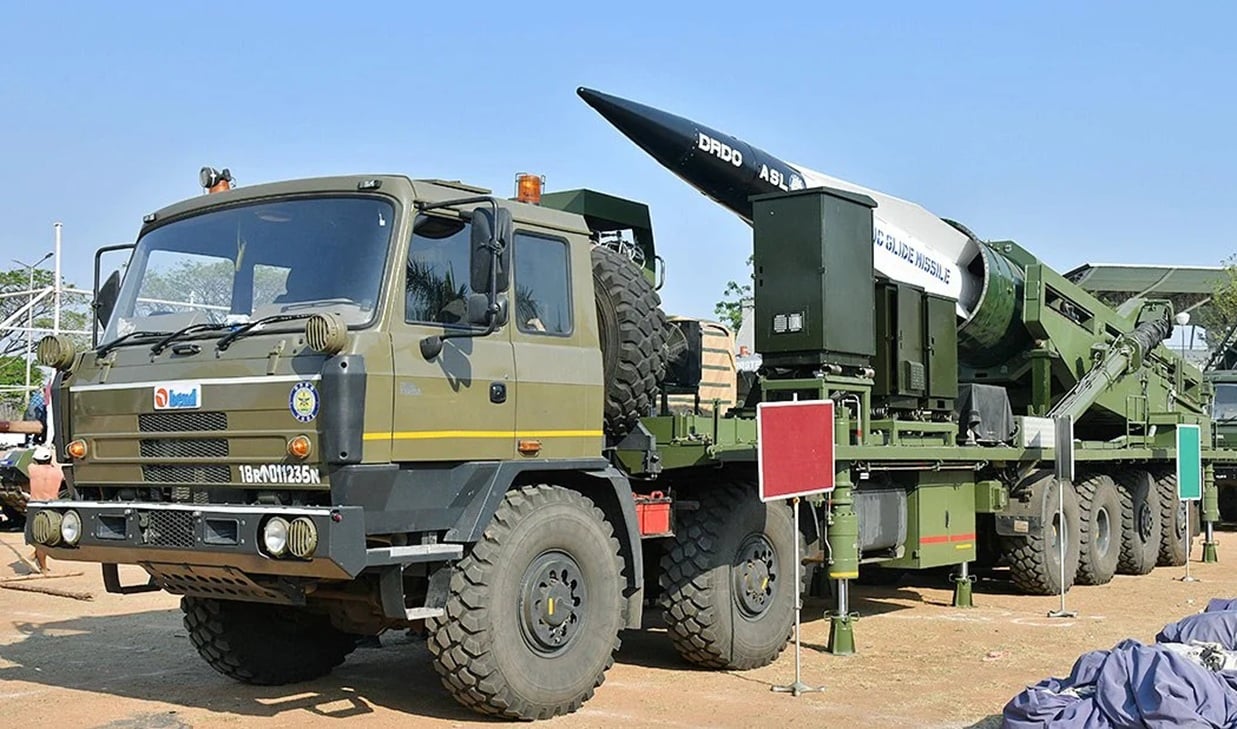
India to Unveil LRAShM Hypersonic Weapon System
India is set to publicly unveil its Long Range Hypersonic Anti-Ship Missile (LRAShM) during the Republic Day parade on January 26, marking the first official presentation of the country’s longest-range hypersonic strike weapon developed for maritime operations.
The missile, formally known as the Long Range Anti-Ship Missile, is a boost-glide hypersonic system developed by the Defence Research and Development Organisation (DRDO) for use by the Indian Armed Forces. Indian defense officials have confirmed that the system will be displayed as part of the annual military parade in New Delhi, which traditionally serves as a platform to reveal new strategic capabilities.
LRAShM is designed as a strike weapon intended to engage high-value naval targets at long range. The missile uses a hypersonic glide vehicle (HGV) mounted on a solid-fuel booster that accelerates the payload to hypersonic speed before releasing it into a maneuvering glide phase. According to Indian defense sources, the system has a demonstrated range of at least 1,500 kilometers and is intended for use by the Navy, Air Force, and Army in multiple configurations.
The glide vehicle features a delta-wing design and is capable of performing terminal maneuvers during the final phase of flight, allowing it to alter its trajectory while approaching a target. This flight profile is designed to complicate detection and interception by shipborne air defense systems. Once released from the booster, the HGV follows a highly adaptive path at hypersonic speed before descending toward the target area.
The missile is cold-launched from a hermetically sealed canister, a method intended to improve safety and storage life. Before the first-stage rocket motor ignites, the system fires attitude control thrusters twice to stabilize the missile after ejection. Approximately eight seconds after lift-off, the missile transitions from a vertical to a horizontal flight profile in roughly six seconds, beginning its boost-glide trajectory. The propulsion system consists of two solid-fuel stages: a booster and a hypersonic sustainer motor.
Aerodynamically, the missile uses a cruciform mid-body design with short-span, long-chord control surfaces, while the aft section features four triangular fins that provide stability during high-speed flight. The configuration is intended to reduce drag at hypersonic velocity while maintaining maneuverability during the glide phase. The design also allows the missile to perform controlled maneuvers in the terminal stage, a key requirement for engaging moving naval targets.
According to information accessed by idrw.org, DRDO and the Indian Navy are working under tight timelines to ensure the missile is inducted into naval service by 2029. The system is expected to be deployed from surface platforms initially, with future integration on air and potentially submarine platforms under evaluation.
Indian defense planners view LRAShM as a central element of the country’s evolving maritime strike and deterrence posture, particularly in the Indian Ocean region. The missile is intended to provide stand-off capability against surface combatants and carrier groups operating at extended distances from India’s coastline.
Unlike subsonic and supersonic cruise missiles, the hypersonic boost-glide profile compresses reaction time for defending ships by combining speed with maneuverability throughout flight. The missile’s ability to alter course during the terminal phase is designed to reduce the effectiveness of layered naval air defenses, which typically rely on predictable flight paths for interception.
The unveiling of LRAShM follows several years of hypersonic research by India, including successful tests of hypersonic technology demonstrators and long-range boost-glide vehicles. Indian officials have stated that the program draws on data collected from multiple flight trials, although detailed test timelines remain classified.
The Republic Day display is expected to confirm that LRAShM has entered an advanced stage of development and is approaching operational readiness.